Free people may choose to sell themselves into slavery to provide for their families. Those slaves who are purchased by the Imperium itself rather than private individuals are called Servus Publicus, or state-owned slaves…[1]
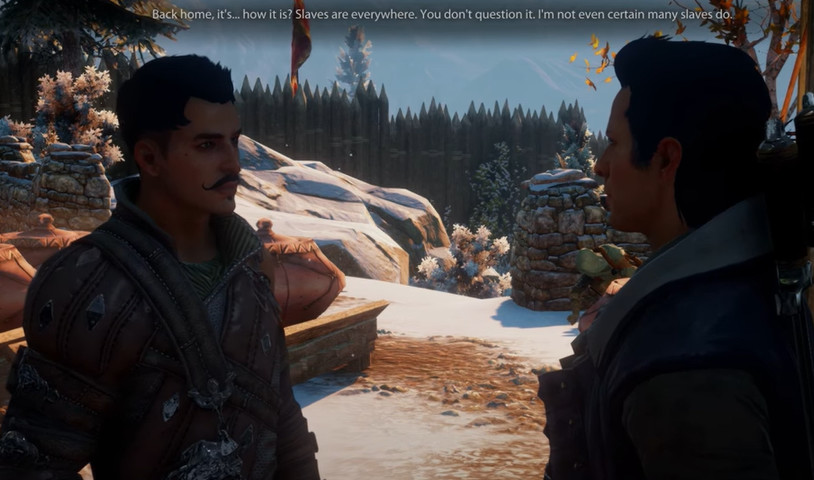
In Dragon Age: Inquisition, a codex entry notes of the servus publicus that they “do all the tasks proper citizens will not.”[2] Tevinter mage and oft-beloved party member Dorian paints a rosier picture:
Dorian: In the south you have alienages, slums both alien and elven. The desperate have no way out. Back home, a poor man can sell himself. As a slave he could have a position of respect, comfort, and could even support a family. Some slaves are treated poorly, it’s true, but do you honestly think inescapable poverty is better?
Inquisitor: At least they’re free. They don’t have slavery forced on them.
Dorian: You think people choose to be poor and oppressed? I doubt it…
A similar conversation crops up in Mass Effect 2 on the planet Illium:
Shepard: I can’t believe an asari world would allow slavery!
Concierge: We try to avoid calling it slavery. All indentured servants on Illium have voluntarily agreed to a term of service. Most choose indentured service as a means to pay off debt or avoid imprisonment. A contract holder is responsible for the well-being of her servants, and a servant’s duties are agreed upon before the contract is signed.
The reality is less sanitised – as the player walks around Illium, an ad for a company called ‘IndentureTech’ plays in the background:
You’ve been a slave to your employees for too long. Shouldn’t it be the other way round?
In these examples, enforced slavery is distinguished from voluntary slavery. In what follows, we consider whether volunteering makes a moral difference.
For the purpose of our discussion, we can ask of the Bioware examples two questions:
With regards to (1), one possible response is that indentured servitude standardly comes with limiting conditions built-in: you have to work to pay back x amount of money, or for y years, or until z event. Looked at this way, indentured servitude might be thought of as being more like an exceptionally onerous employment contract than like slavery – there are difficult conditions attached to escaping them, but it’s possible (by design). The indentured servant gives ten years’ service and is free; the volunteer army recruit gives three (or five, or seven) years’ service and is free. It’s not even unusual for there to be very punitive clauses dealing with what happens if the contract’s broken. So perhaps we should just think of indentured servitude as being high-risk (and, uh, low-reward) employment: if you don’t want to take the risk, don’t take the job. The invisible hand of the market solves the problem once again!
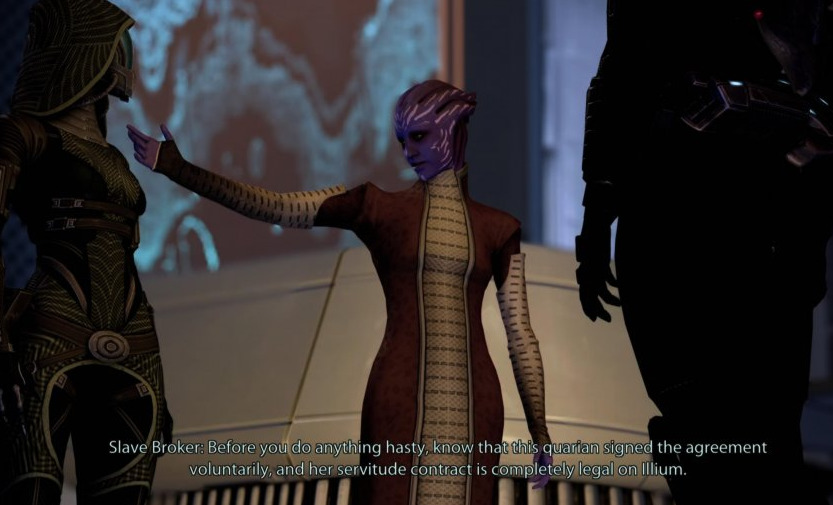
Well, no. As it happens, there are good reasons to think of lots of modern employment contracts as forms of indentured servitude, including the ones given above – but that just means that many more people are in effect in servitude than we usually think.[3] This isn’t quite to re-assert the old claim that wage labour is slave labour, but it should make us wary of going “well really it’s just like being a wage labourer under capitalism, so obviously indentured servitude isn’t like slavery”.[4] Rather, it should suggest to us that if there is a relevant distinction between waged labour, indentured servitude, and slavery, it’s not (or not primarily) to do with how difficult it is to escape the respective conditions or even the consequences of doing so.
Instead, we might think the crucial difference is to do with power and power structures: specifically, the extent to which one’s freedom or ability to do otherwise than the boss says is a matter of structural power (im)balances. Let’s take two simplified cases.
Case 1: Kim Kitsuragi is employed by RCM as a police lieutenant. There are certain restrictions on what Kim may do at work, and on how many hours a week Kim can spend out of work. These restrictions are built into Kim’s contract.
Case 2: Crypti is a slave on a cocaine plantation on the Irmalan Plateau. There are restrictions on what Crypti may do at work, and how many hours a week Crypti can spend out of work; there are also restrictions on where Crypti may live, who they may see, probably who they may have intimate relationships or children with. These restrictions may or may not be formalised.
Crypti is situated such that by design their life is vulnerable to arbitrary interference at the whim of another – in the philosophical jargon, they’re dominated (see Pettit 1996; 1997). It’s not just that somebody could interfere with their life, it’s that the social structures they inhabit are designed to make this possible. Conversely, the social structures that Kim inhabits are designed to limit how much his employer can interfere with his life. These structures might be – are likely to be – imperfect.[5] Still, their explicit goal is to make sure that Kim is able to make his own decisions not only about how to do his job, but more importantly whether or not to do his job at all. Kim is non-dominated, while Crypti is dominated – and they seem to be dominated in just the way that the people in the Bioware examples are dominated (a servus publicus cannot choose to become a merchant instead).
So we have reason to think that Tevinter and IndentureTech are indeed engaging in slavery, and can turn to the second question: Does volunteering make a difference?
To answer this question, it helps to think about autonomy. What you conclude will depend on whether you think of autonomy primarily as a matter of knowing what you want to do; of doing what you want to do with your life; or of being able to control how your life goes.[6] Let’s consider each of these in turn.
Taking the first line, we find people like Frankfurt (1971) and Dworkin (1976; 1981). According to them, autonomy is – very roughly – a matter of endorsing your first-order desires at a higher-order level. Say you have some first-order, world-facing desire, like “I want a pint”. If you want this desire to be effective – if you endorse its efficacy at a higher-order level – then according to them you’re autonomous. Under this view autonomy is a psychological matter, one to do with the efficacy of the “deep” or “true” self over its first-order desires. So long as the enslaved agent continues to endorse those desires that point them in the direction of slavery, it is indeed conceptually possible to be an autonomous slave.[7]

Regardless of whether you think this is convincing in the slave case, there are reasons to be suspicious of structuralist views. Suppose that a Tevinter woman becomes a servus publicus, reasoning that it is the best (and perhaps only) way to save her family from poverty, but feels considerable grief at the loss of her former freedom. In other words, she has a first-order desire to be free, but endorses her servitude at a higher-order level. Marilyn Friedman (1986: 31) pointed out that on views like Frankfurt’s and Dworkin’s, the servus publicus would be made more autonomous by rejecting
“her frustration grief and depression, and the motivations to change her life which spring from these sources…[and which] may be her only reliable guides.”[8]
That is, supposing that she still endorses the servitude, still “wants to want” to be a good servant, then under the structuralist model she would become more autonomous by squashing the desire to chib the overseer, set fire to the big house and run like hell for a less constrained life. This seems – to use the technical term – exactly bass-ackwards to Friedman. Thinking about why might be illuminating.
Generally, we think of autonomous agents as not merely knowing (more or less) what they want out of life, but also being able (more or less) to get it. In Friedman-type cases, though, it seems not only that you can become more autonomous by subordinating what you want to some pre-existent conception of what you should want, but also that whether you get what you want is irrelevant to whether you’re autonomous.
“You think people choose to be poor and oppressed? I doubt it…”
A response might be to invoke what’s called procedural independence, in other words, that how you form your desires is important too. The procedural independence theorist is likely to say of the voluntary slave that something is amiss with how they’ve formed the desires to be subservient – faced with the choice between slavery or starvation, the person is making choices that, because of the pressure, don’t represent who they “really” are. This may well be true in lots of cases, but i) we ought to be careful of suggesting that people aren’t competent over their own desires, and ii) it still doesn’t evade the problem that so long as your desires line up right - or have been/can be subjected to critical thought - whether they’re met doesn’t matter for autonomy. This seems weird considering that “living a life of one’s own” is near-as-damnit the one-line gloss on what it is to be autonomous.
“Aha!” say proponents of what’re sometimes called the self-authorship family of views, “precisely! In these cases, your desires might represent the real you, but your life isn’t the life that you want, and so you’re not autonomous”. According to them, to be autonomous is to “decide for [yourself] what is valuable, and to live [your] life in accordance with that decision” (Colburn, 2010). On this view, so long as the agent has thought carefully and critically about what they want, then they are autonomous insofar as they get what they want. The same will apply for the person who wants to be enslaved. Again, almost nobody thinks that this is likely, but it’s a conceptual possibility: it is possible to be an autonomous slave, if the life of slavery is consistent with your decisions about what is valuable.
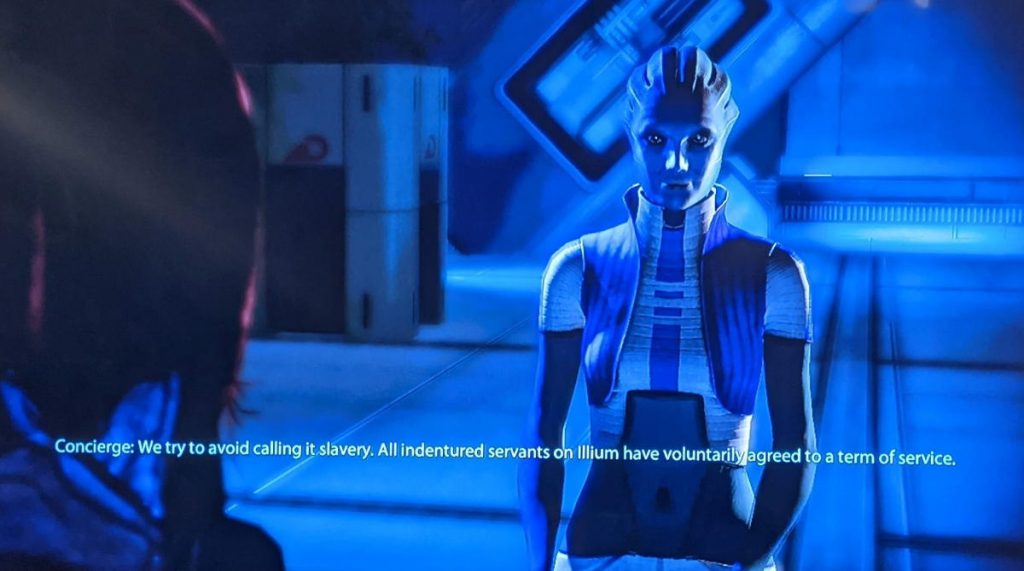
And, obviously, this explains why voluntariness is important: if you choose to x, under conditions of procedural independence, then it seems fairly safe to say that x-ing represents what you want out of life – that you’ve decided for yourself that x is valuable, and can now live in accordance with that decision. Under the views we’ve so far considered, then, the IndentureTech employee and the servus publicus could be autonomous, although it’s unlikely.
The relational view offers a different analysis.[9] On this view, what it is to be autonomous is to be (more or less) in control of your life – to be socially situated such that your desires about life are taken seriously precisely because they’re your desires, and that you are able to pursue these desires. In other words, to be authoritative and powerful over the direction of your life. Someone who’s enslaved is not powerful over the direction of their life; definitionally, they’re vulnerable to interference at the whims of another.[10] Under a relational account, then, the slave isn’t autonomous.
"You’ve been a slave to your employees for too long. Shouldn’t it be the other way round?"
Interestingly, this means that voluntariness doesn’t make a difference: you may very well have been autonomous when you decided to commit yourself to slavery, but once that’s happened you aren’t any longer. Imagine that you freely decide to be tied up. Once you’ve made the decision, your movements are restricted, and the duration of the restriction is now out of your control – hopefully you’ll be released if you ask to be, but you’re much more vulnerable than you were before the binding. Likewise, the servus publicus might have freely sold themselves, but can’t then change their mind and become a hairdresser instead.
That’s not to say that voluntariness doesn’t matter for relational theories. It’s clearly important for being powerful and authoritative that your choices are taken seriously, and so voluntariness is important. But it’s not a sufficient condition for autonomy – it’s not enough. Merely wanting to do something doesn’t mean that doing it makes you autonomous. Autonomy relationally construed is a social phenomenon, and so – perhaps counterintuitively – we’ve got really strong reasons to prevent some kinds of relations from obtaining. Voluntary or no, your boss having near-untrammelled power over how your life goes is not consistent with your being able to decide how your life goes.
As Dorian notes, “Abuse heaped on those without power isn’t limited” to slavery. But choosing slavery doesn’t mean that what’s ‘heaped on’ isn’t abuse.
[1] https://dragonage.fandom.com/wiki/Slavery
[2] An in-game Codex entry, attributed to In Pursuit of Knowledge: The Travels of a Chantry Scholar by Brother Genitivi. Full text available at https://dragonage.fandom.com/wiki/Codex_entry:_Tevinter_Society.
[3] You’ll have noticed, for example, that “don’t take the job” is real easy advice to dispense from a comfy armchair, but carries all the heft of a gnat’s fart if taking the job is the only alternative to penury and starvation.
[4] Cohen (1982) draws this queasy parallel, though he does at least admit that he probably ought not to be equating wage labour and chattel slavery.
[5] That’s why you should join a union. Go on, I’ll wait.
[6] But wait, aren’t these last two the same thing? No, as <takes hold of tablecloth meaningfully> I’ll go on to suggest.
[7] I should add that neither of them think this is especially likely, though.
[8] Friedman’s original example refers to someone confronting internalised misogynistic norms regarding “a woman’s place”.
[9] Strictly, the constitutive social-relational view. See Oshana (1998; 2006).
[10] I also think that enslavement relations must deny the authority of the agent, but we can leave that aside.
For more examples of in-text justifications for slavery, check out the TV Tropes page on "Happiness in Slavery".
To learn more about philosophical accounts of autonomy, you could start with the Stanford Encyclopedia of Philosophy entries on autonomy in moral and political philosophy and feminist perspectives on autonomy.
]]>Flyting – examples of which can be found throughout Northern European literature, from Irish and Scots to English and Norse – was a performative exchange of insults between poets that celebrated their wit, eloquence, and general capacity to be a Bad Bitch
. These verbal (and textual) duels typically comprised insults focussing on a foe’s sexual perversion, their lack of courage in battle, or their physical ineptitude, and were frequently, joyously vulgar. Think Christmas dinner conversation with your favourite drunk aunt.
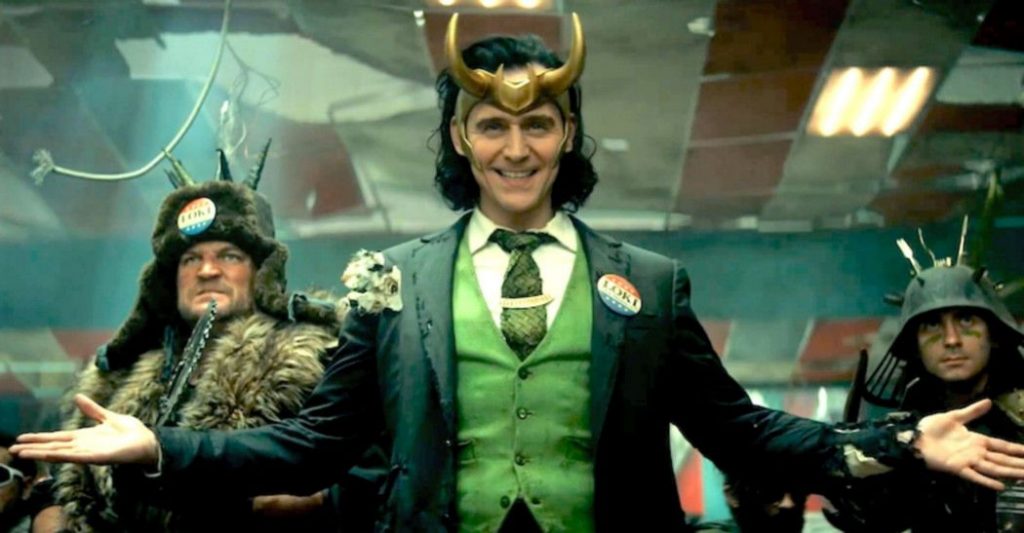

An early example can be found in the Lokasenna (or The Flyting of Loki), a poem from the Poetic Edda which depicts the poetical invectives between Loki and the Æsir (the main pantheon of Gods in Norse mythology). Below we have an excerpt from an exchange between Loki and Bragi (the god of poetry and music no less):
Bragi spake:
"Now were I without | as I am within,
And here in Ægir's hall,
Thine head would I bear | in mine hands away,
And pay thee the price of thy lies."Loki spake:
"In thy seat art thou bold, | not so are thy deeds,
Bragi, adorner of benches!
Go out and fight | if angered thou feelest,
No hero such forethought has."
Bellows (1936): 151-152.
“[A]dorner of benches” – is there a more devastating accusation of cowardice? The first line is Loki essentially decrying Bragi as a keyboard warrior: sweating Mountain Dew and explaining comedians’ jokes back to them on Twitter.
Bragi, conversely, does seem somewhat less well-stocked in the ol’ wit department: “You wouldn’t like me when I’m angry” he says: “Don’t make me get off my chair! I swear, if I have to stand up! Mum! He’s doing it again!” I squared up to my grandma in this fashion once; she punched me in the throat.

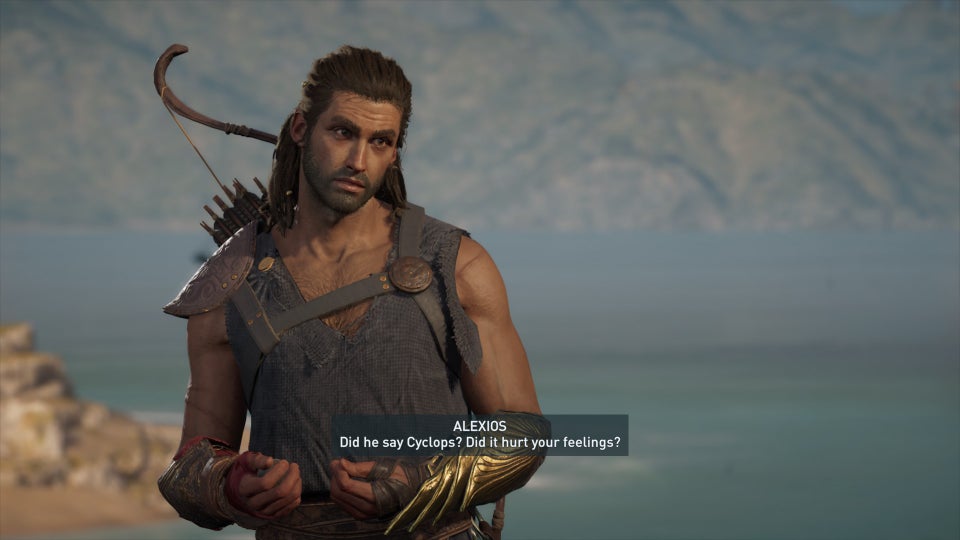
Which brings us to Valhalla (2020). Ubisoft’s Assassin’s Creed: Odyssey (2018) was a phenomenal recreation of the ancient Hellenic world – just ask this archaeologist – and they’ve taken a similarly well-researched approach to Valhalla: from silver coinage to longship design. “But it was wildly historically inaccurate: that’s not how kings were chosen!” I hear you shout from your basement, dribbling soda. I don’t care: back to the bench with you! (I will concede, however, that male Eivor is not nearly as hot or funny as Odyssey’s Alexios, and no I will not surrender the tannoy in Tesco until everyone shopper knows this).

For me (and therefore for you), the most notable historical inclusion was, of course, flyting. These stats-boosting poetic duels are common throughout the map in both Norway and England, and will test your ability to detect rhyme and intuit metre. Some bold-as-brass NPC drops a phat insult against you, and you – absolutely raging by this point – have to select your response from three available choices. The correct one is that which complements both the NPC’s end-rhyme (final sounds which rhyme e.g. 'I serenaded the old woman who lives across from my door | She bade me “shut the fuck up” and called me a whore') and its number of feet.
Feet, for the unfamiliar, are a basic unit of measurement in poetry: collections of stressed and unstressed syllables which structure the rhythm of a poem. For example, the word unite is comprised of an unstressed syllable followed by a stressed syllable. Typically, these are characterised as dee – short, unstressed – and dum: longer, stressed. Whether a syllable is stressed or not is dependent on the emphasis placed on it during an utterance: for me, the emphasis is placed on the second syllable when I say ‘unite’: dee-dum. This may not be the case for everyone: heretics undoubtedly live among us.
“[A]dorner of benches” – is there a more devastating accusation of cowardice?
Now, there are all kinds of feet (beyond nice ones like mine and everyone else’s gross ones). ‘U-nite’ for example, is an iamb: an unstressed syllable followed by a stressed one. Byron’s She Walks in Beauty is a nice example of iambic metre: “She walks in beau-ty, like the night.” A trochee, conversely, is a stressed syllable followed by an unstressed syllable e.g. Gar-den. Poe’s famous The Raven is primarily written in trochaic metre: “Once u-pon a mid-night drea-ry, while I pon-dered, weak and wea-ry.” And you certainly aren’t limited to two syllables. An anapaest is two unstressed syllables followed by a stressed one e.g. O-ver-come. You’ll find an example of this type of foot in Byron’s The Destruction of Sennacherib – absolute banger if you haven’t read it: “When the blue wave rolls night-ly on deep Gali-lee.” And they said an undergrad in English literature was a waste. I may have debt and limited job opportunities but behold! My mountain of incredibly google-able knowledge!

Armed with this understanding of Valhalla’s flyting victory conditions, let’s consider this early encounter with Manning, Fighter of Wolves. A burly type, I was initially surprised by his eloquence – shame on me. His opening volley is: “Have you ever seen muscles as massive as mine?” And to be fair, his muscles are sizeable and inspire in me unclean thoughts. Our task is then to select from the three options the ending which best complements this line and, of course, delivers a devasting riposte. Listening to the museful Manning, he is using iambic metre: unstressed syllable, stressed syllable. Our three options are:
“You have the form of a very large swine.”
Wrong: this is in fact a savage put-down from my mother when I’m just trying to enjoying a swim at the pool. And it’s not entirely iambic – I’m hearing a couple of cheeky trochees in there – and there certainly are not enough feet (said the cannibal to the chef).
“I’m not awed by your muscles, but shocked by your pride.”
Also wrong: a yearbook entry from my favourite PE teacher. “I’m not awed” reads as anapaestic to me, and “pride” doesn’t work as an end-rhyme.
“What you make up in muscles, you’re lacking in spine.”
Boom! We have a winner! “Spine” compliments the end-rhyme of “mine,” and you can comfortably read it aloud as iambic. Also a direct quote from my concerned chiropractor.
...these kinds of poetic and literary pursuits are steadily finding their way into more games...
Beyond Valhalla, we can find numerous examples of flyting in modern media. In the final installation of Rick Riordan’s Magnus Chase and the Gods of Asgard trilogy, The Ship of the Dead, the eponymous protagonist flytes to the death with Loki (an event involving body-shrinking and walnuts, I don’t know).
In the Monkey Island video game series (and especially The Secret of Monkey Island), flyting is integral to victory in sword-fighting: as in Valhalla, you must counter your opponent’s invectives with insulting (and, in the sequel, rhyming) ripostes. A sufficiently stinging jibe will throw your enemy off and give you the upper hand in battle, which, if maintained for long enough, secures you the win. Memorable exchanges include:
“I once owned a dog that was smarter than you!”
“He must have taught you everything you know!”
And:
“You fight like a dairy farmer!”
“How appropriate. You fight like a cow!”

Perhaps most heartening is that these kinds of poetic and literary pursuits are steadily finding their way into more games with meaningful narratological and ludological function: see also the haiku quests in Ghost of Tsushima.
And if you’ve an interest in the ritual insulting of others (and if you don’t: why do you hate fun?), I would recommend The Flyting of Dunbar and Kennedie (the earliest example of flyting in Scots: c.1500 baby), which has been suggested to possess the earliest recorded use of the word ‘shit’ as an insult. A particularly delightful line is Kennedie’s accusation that Dunbar is: “a shit without wit, only cheap tawdry tricks.” The perfect Twitter bio, frankly.
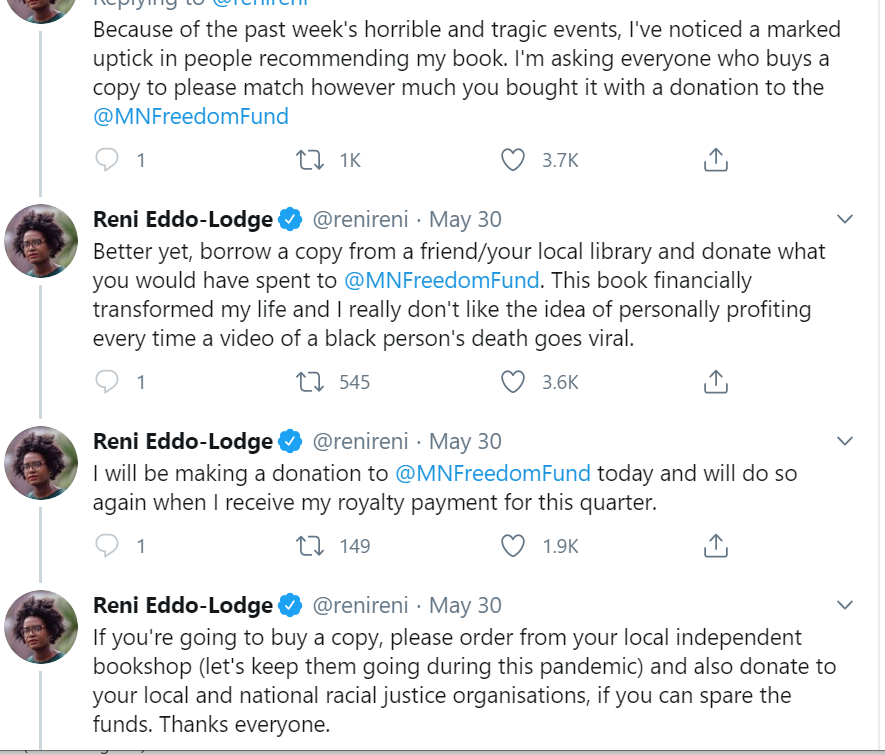
The Epicurean Cure is a celebration of thinking critically and robustly about the media we love. Further down you’ll find a selection of works by BAME authors: those that sit with worn spines on our bookcases; that we’ve read to the children in our lives; that we’ve pressed into the hands of friends; that we’ve sat up into the wee hours consuming. We’ve also included a series of links to other media created by BAME people or that give context to the current protests (those aren’t mutually exclusive!). Buy them from your local bookseller, borrow them from your local library, watch them, play them.
However, that’s not all you can do. We can’t speak to the lived experience of BAME people so must defer to those who can, and the overwhelming message we’re hearing is to donate, so that’s what we’ve done. Here are some resources with suggestions of where you can direct your time and funds:

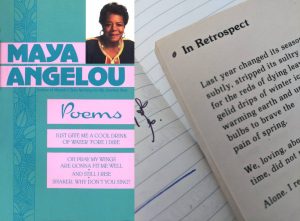
The philosopher’s well-worn copy collects four volumes of Maya Angelou’s poetry: Just Give Me a Cool Drink of Water ‘Fore I Diiie; Oh Pray My Wings Are Gonna Fit Me Well; And Still I Rise; Shaker, Why Don’t You Sing?

Her 17-year-old self marked favourites with dots in the corner of the pages, but every time she opens the book something new resonates. Zen Pencils' Gavin Aung Than illustrated “Phenomenal Woman”, and it’s well worth a look.
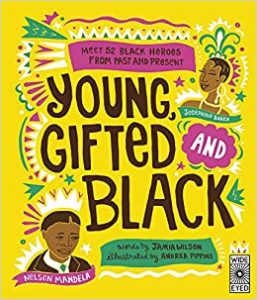
This gorgeous picture book depicts fifty-two black legends – one for each week of the year. It’s brightly coloured, uplifting and covers musicians, politicians, athletes and other important figures from all over the world.

You can find more picture books celebrating BAME people in Quarto’s "Anti-racist books for kids” list.
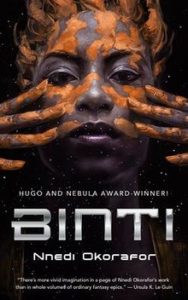
The first in a trilogy of stories about Binti, the linguist defies anyone not to read it in a single sitting (also it’s a novella, so you really don’t have an excuse). Tense, textured, thoughtful – Okorafor’s gift for characterisation keeps this story in your thoughts long after the last page.

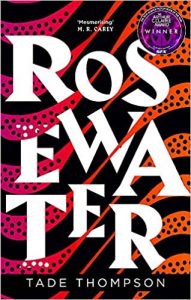
The first of a sci-fi trilogy set in Nigeria, Rosewater is widely acclaimed and it’s not difficult to see why. Both the philosopher and the linguist amongst us read and enjoyed it, and we tend to disagree about books, so that speaks for itself.

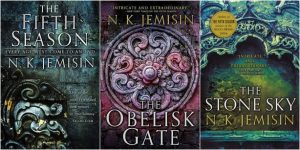
These are excellent, simpliciter. The trilogy is described as ‘science fantasy’ and has fascinating world-building and multi-layered female characters. Jemisin was the first African-American author to win the Hugo Award for Best Novel, which she did for the first in the trilogy: The Fifth Season. She went on to win the Hugo for both sequels, The Obelisk Gate and The Stone Sky.

The only reason our own copies don’t feature in the image at the top of the page is that they’re constantly being loaned out to friends. The web dev waxes lyrical about how great they are – the rest of us agree.
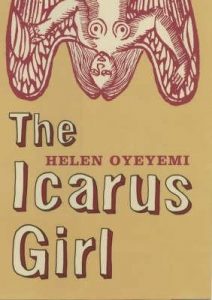
This is a phenomenally easy-to-enjoy read. Oyeyemi took time off school to finish it and the linguist is glad she (temporarily) said screw you to maths. A coming-of-age (sort of ghost) story set against the background of cultural upheaval; it was a pleasure to read.

We’re grouping these two together for two reasons: (1) they’re both accessible, important insights into current society, history, and the lives of people of colour in the UK; and (2) there’s currently a petition to have them added to the GSCE reading list (which you can sign here). There’s an American version of the latter – The Good Immigrant USA – edited by Nikesh Shukla and Chimene Suleyman.

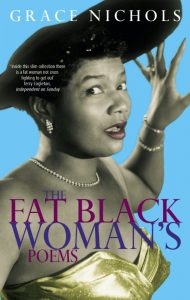
We’d be remiss not to include Grace Nichols’s poetry: often hilarious, regularly moving, and always powerful. It was, and continues to be, an important joy to read.

If anyone has further suggestions we’re happy to share them, and if there’s anything in particular we can do, we’d appreciate hearing it.


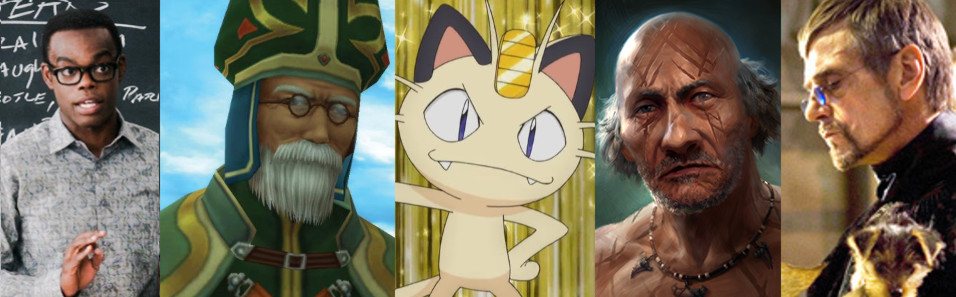
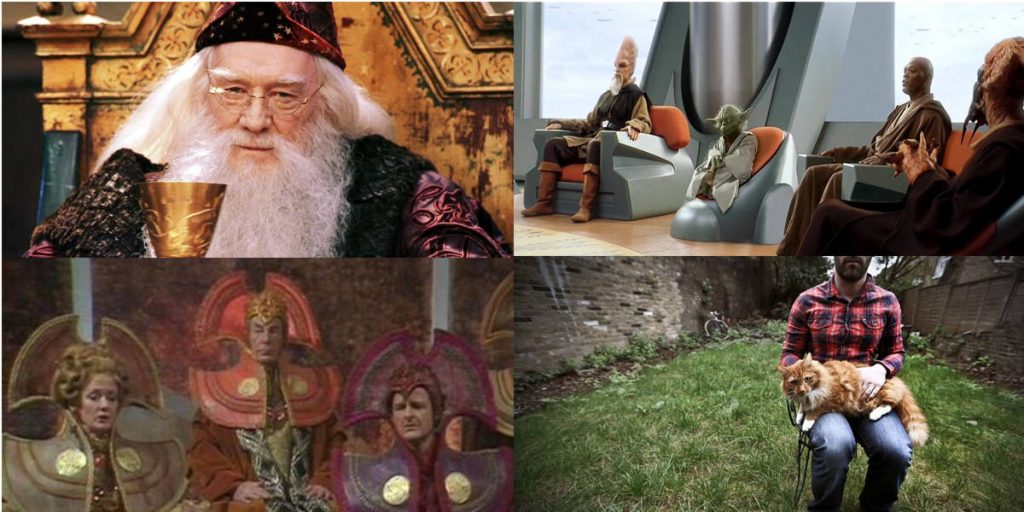
Those who ascend to rulership become Philosopher Kings[1]:
It is a more enlightened age. Perhaps a future, or a past long forgotten, when rulers are noble and just, and rule for their people, not just for themselves. Perhaps it is an Age of Reason, in which older, barbaric measures of manhood such as war and business have been phased out, and replaced solely with pure, unclouded Thought. Only those who have the capacity to Think have the right to Rule. In this realm, the Philosopher King is found.[2]

In this short but sweet piece of pop(culture)corn, we highlight some gender-inverted instances of the Philosopher and Philosopher King. Let us know your favourite, or other characters deserving the mantle of Philosopher Queen, in the comments or on Twitter/Tumblr/Facebook.
"Eternal life for those who can afford it means eternal control over those who can’t."
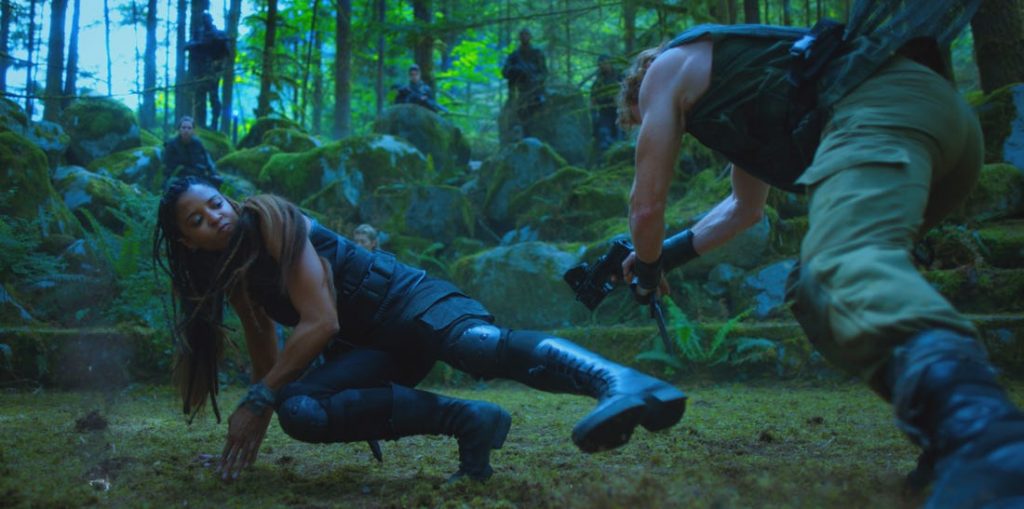
Quell is an academic and political revolutionary in Richard Morgan’s Altered Carbon. The Netflix adaptation presents her as a fighting philosopher rebel queen, whose actions against the ruling elite are underpinned by her eponymous political philosophy:
Quellism is the political theory created by Quellcrist Falconer for the establishment of a hi-tech social democracy, having elements of socialism and anarchism. Quellism was an expression of Quell’s exasperation with both the inherent self-serving, elitist, corruption of right-wing politics and the back-biting, self-absorption of the left.[4]

Technological developments have allowed the rich to prolong their lives indefinitely, ‘resleeving’ their consciousness in new bodies – in the Altered Carbon universe, Quell notes, “Your body is not who you are.”[5] The political ramifications of this motivate Quell’s revolution:
The ebb and flow of life is what makes us all equal in the end […] We aren’t meant to live forever. It corrupts even the best of us…Eternal life for those who can afford it means eternal control over those who can’t.
Quell (S01E07)
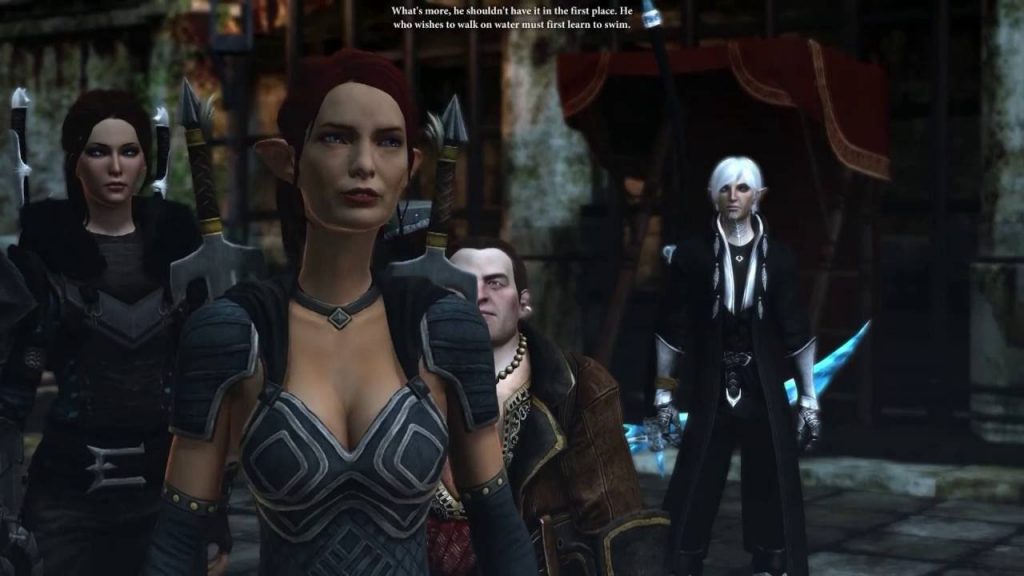
Tallis is an elven, Qunari assassin, from Dragon Age II’s “Mark of the Assassin” DLC. A convert to the Qun, Tallis engages in both epistemology and moral philosophy, contemplating her faith and her moral obligations.

In classic trope-philosopher fashion, she delivers pithy one-liners as she accompanies the party:
He who wishes to walk on water must first learn to swim.
She who swallows wisdom in tiny chunks avoids choking.
It’s not always meant to end in violence. There are other paths. They do not all need to lead to the same destination.
Doubt is the path one walks to reach faith. To leave the path is to embrace blindness, and abandon hope.
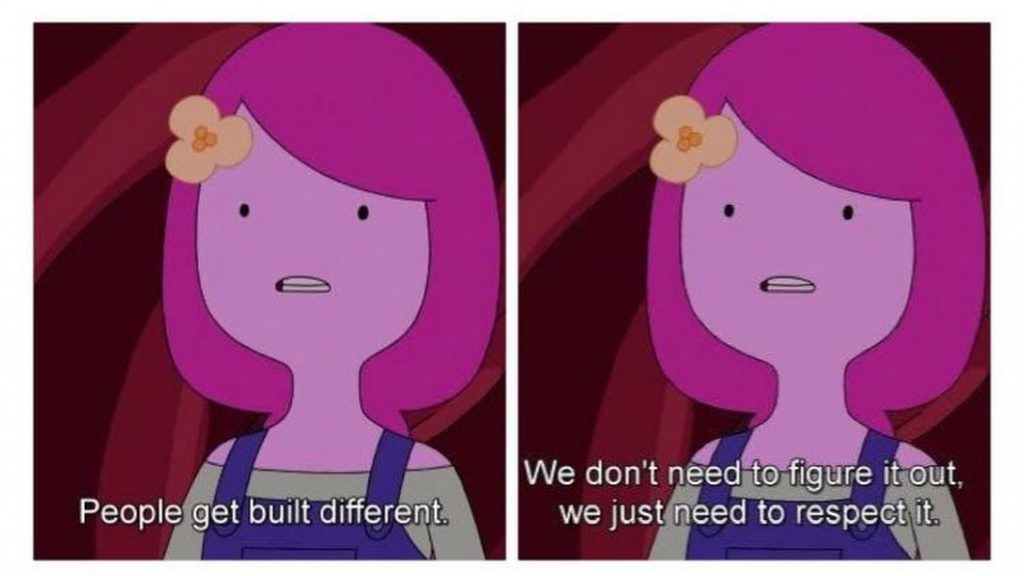
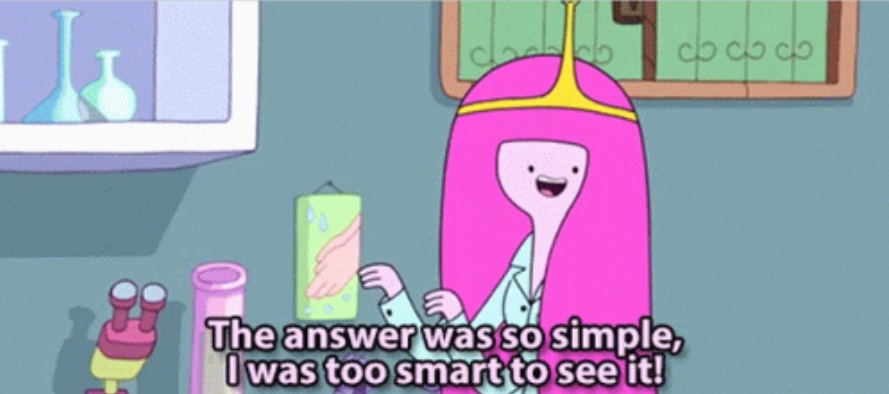
A literal philosopher queen – or at least, philosopher princess – Bubblegum rules the Candy Kingdom in Adventure Time, a prosperous land of sweet creatures with a tendency to explode when frightened. A metaphysician and philosopher of science, Bubblegum champions invention and empirical endeavours while denying the existence of magic:
Listen, all magic is scientific principles presented like “mystical hoodoo” which is fun, but it’s sort of irresponsible.
Princess Bubblegum, Wizards Only, Fool

In the course of the show, Bubblegum attends and organises conferences, fashions a potion to revive the dead, and creates a variety of creatures (including her own subjects) out of candy biomass:
As princess of candy kingdom, I’m in charge of a lot of candy people. They rely on me, I can’t imagine what might happen to them if I was gone… I am not going to live forever Finn, I would if I could, but modern science just isn’t there yet, so I engineered a replacement that could live forever.
Princess Bubblegum, Goliad

And, in true tropey fashion, Princess Bubblegum acts as a guide to the show’s adventuring heroes, Finn and Jake, sharing her wisdom and providing exposition:
Finn, sometimes you want someone and you want to kiss them and be with them, but you can’t because responsibility demands sacrifice.
Princess Bubblegum, Burning Low
"Doubt is the path one walks to reach faith. To leave the path is to embrace blindness, and abandon hope."
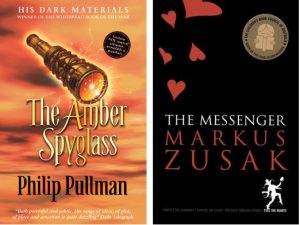
Mary Malone is a physicist and the inventor of the eponymous device in Philip Pullman’s Amber Spyglass. Like Bubblegum, she is foremost a scientist, but Mary plays the role of the philosopher in guiding (and tempting) Lyra and Will. Drawing on her background as a former nun, she espouses her philosophy of religion as part of this process:
I stopped believing there was a power of good and a power of evil that were outside us. And I came to believe that good and evil are names for what people do, not for what they are.
Mary Malone, The Amber Spyglass

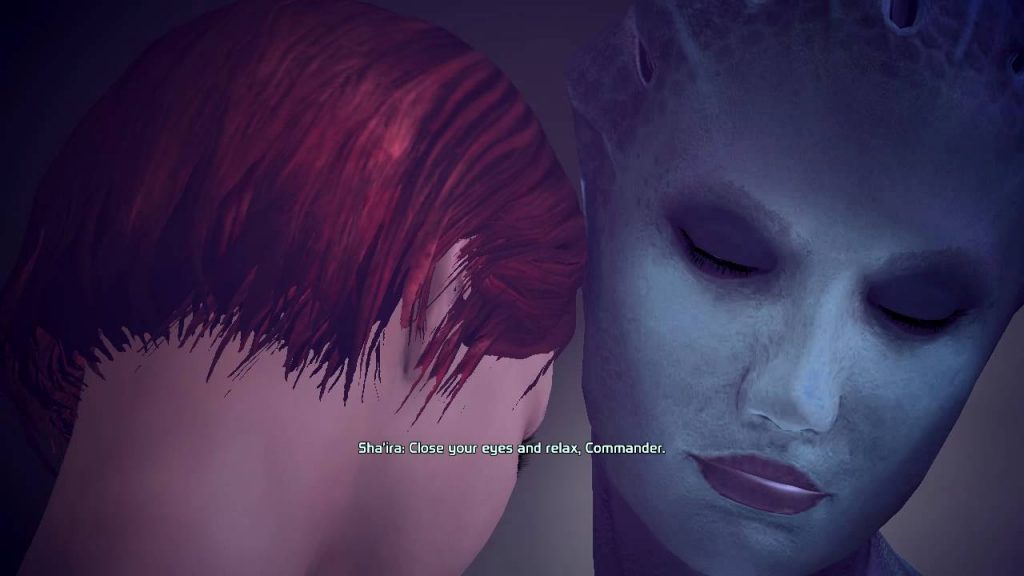
Sha’ira appears in the Mass Effect series, offering “personal services as well as entertainment and conversation”[6], but she is particularly sought after for her advice. After providing assistance to the consort in the first Mass Effect instalment, Sha’ira offers the player character Shepard a ‘gift of words’: “an affirmation of who you are, and who you will become”. Shepard observes that, from description, the consort sounds like an oracle; in this and her advice she is much like the classic trope instances. Another character rejoins that Sha’ira is merely a woman, “with remarkable compassion and a generous spirit”.[7]

Sha’ira has been likened to a Greek hetaira – in both cases, depending on who you ask, they are described as sex workers, escorts, and/or elite, educated women.
Want to philosophise about other examples? Do so in the comments, or on twitter/tumblr/facebook.
[1] The original argument for why it’s a good idea for philosophers to be kings (or kings to be philosophers) see Plato’s Republic, Books VI-VII.
[2] https://tvtropes.org/pmwiki/pmwiki.php/Main/ThePhilosopherKing
[3] The Ruler of the Universe from The Hitchhiker's Guide to the Galaxy, as envisioned by the BBC (https://www.bbc.co.uk/programmes/profiles/RPVK2VZqX2qv6tQPTsLchK/man-in-the-shack
[4] https://altered-carbon.fandom.com/wiki/Quellism
[5] Altered Carbon, S01E01. If you’re interested in what makes you what you are, you can find out more here.
[6] https://masseffect.fandom.com/wiki/Sha%27ira
[7] Nelyna, Mass Effect

Nonetheless, I normally think that the rest of you have minds too, and sometimes I even think I can know what’s going on in that mind of yours. I can’t peer into it, but based on your behaviour, and by analogy to my own experience, I predict what you’ll do, respond to how I think you’re feeling, and so on. Presumably you do that too. After all, if you don’t have a mind – if you don’t feel, or think, or want, or believe – then my efforts to ensure I’ve stocked up on your favourite tea before you visit seem rather pointless. The attribution of minds and mental states to others is ubiquitous: here are a couple of examples from Zusak’s The Messenger[2] (emphasis mine):
She looks up at me, and for a moment, we both get lost in each other. She wonders who I am, but only for a split second. Then, with stunning realisation clambering across her face, she smiles at me.[3]
[...] He’s still groggy but his eyes grow wide. He thinks about a sudden movement but understands very quickly that he can barely pull himself out of the car.[4]
The problem of other minds is an epistemic one: how are we justified in attributing mental states to others, given the possibility that their minds may be very different to our own, if they have them at all? How can we know that others have minds, and what are they like?
These are questions too big for a single article, so here I just want to highlight two things: firstly, that we do attribute minds and mental states to others (whether or not we are justified in doing so, or whether we can know that they have them); and secondly that one argument for doing so is, as I hinted at above, the argument from analogy.[5] Even if I don’t know what your mind is like (or even if you have one), can’t I still reasonably suppose that your mental life is much like mine? Can’t I use myself as a model for you and everybody else?

This sort of argument was put forward by John Stuart Mill and Bertrand Russell, among others. Here’s Mill’s version:
I conclude that other human beings have feelings like me, because, first, they have bodies like me, which I know in my own case to be the antecedent condition of feelings; and because, secondly, they exhibit the acts, and other outward signs, which in my own case I know by experience to be caused by feelings.[6]
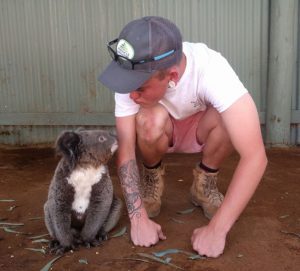
Of course, there are always problems with induction from one case, and one case is all we have, as my mind is the only mind I can be sure about. So, there’s a difference between a generalisation like ‘If a person exhibits human behaviour then they have a mind’ and ‘If you encounter a koala in the wild then you’re in Australia’, because in the latter case we have lots of evidence it’s true (there are lots of instances of people encountering koalas in the wild, and all have taken place in Australia)[7] and in the former I only have on instance: me!

If I was the only philosopher you had ever met, you might come to think that all philosophers were 5ft2, interested in time travel and spoke with an Aussie Accent...

The reality is sorely disappointing.
Can’t I use myself as a model for you and everybody else?
As Simon Blackburn puts it,
The mere fact that in one case – my own – perhaps as luck has it, there is a mental life of a particular, definite kind, associated with a brain and a body, seems to be very flimsy ground for supposing that there is just the same association in all the other cases.
If I have a box and it has a beetle in it, that gives me only very poor grounds for supposing that everyone else with a box has a beetle in it as well.
Perhaps worse, it gives me very poor grounds for denying that there are beetles anywhere else than in boxes.
Maybe then things that are very different from you and me physically are conscious in just the way that I am: rocks or flowers, for example.[8]
Even if we can move past this worry, there’s another: even if the argument from analogy works for people similar to me, what about creatures who are dissimilar? And how different is too different: people with behaviour or bodies different to mine? Animals? Aliens?
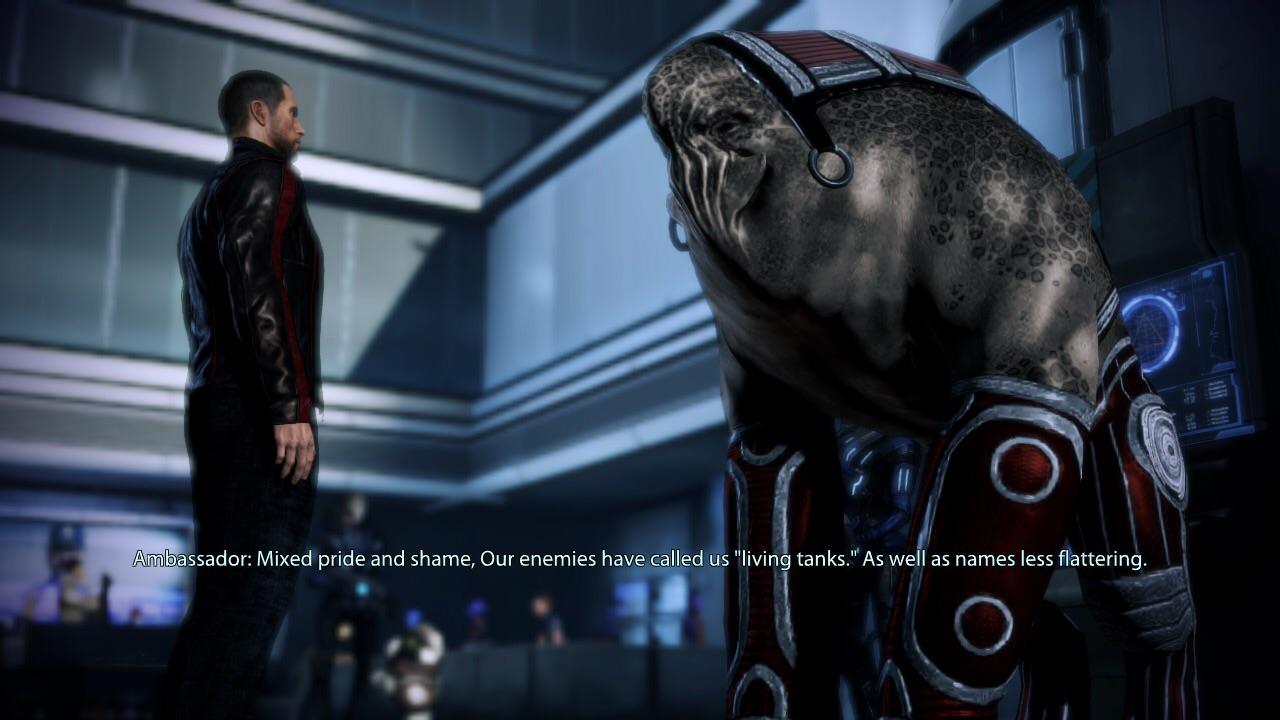
And thus we arrive at Mass Effect. One of the things I like most about the series are the aliens. Less the humanoid aliens – although they’re fun too – but the truly alien aliens. Two are particularly of note (I’m borrowing the descriptions of TVTropers for these, as they’re priceless). First there are the Hanar, who
look something like dog-sized pink jellyfish with seven feet long tentacles, speak through bioluminescence (using Translator Microbes to communicate with other species), and have the tendency to refer to themselves as “This one” (because to the hanar, using one’s name in public is egotistical).[9]

The elcor, by contrast,
resemble elephants without trunks that have been crossed with gorillas and stand about two metres tall at the shoulder. As their communication relies heavily on body language and pheromones (both too subtle for other species to decipher), they lack the ability to talk in anything but a flat monotone, which they compensate for by beginning their sentences by stating [their emotional states]…even when it is “With barely contained terror: Fine have it your way.”
However, except for their body size and unusual speech, they appear perfectly normal when interacting with other species.

The bodies and behaviour of the Hanar and Elcor are very different to ours – much more different than many of the aliens we see in science fiction.

Nonetheless, it seems, they think, feel, desire, believe. Putting aside their being fictional, there is presumably something it is like to be a Hanar or an Elcor. And we have reason to believe that at least some of what’s going on in their minds is similar to what goes on in ours. The Hanar merchant Opold displays concern for the impatience of one of its[10] customers, and depending on the player’s actions can become angry. A particularly devout Hanar on the citadel argues to be allowed to preach on the basis of its desire to share the truth of its Gods. The Elcor too make reference to recognisable mental states states when speaking – exasperation, shock, horror, worry, delight – in contexts where we might feel the same: concern for guards that haven’t slept, shock at someone discovering a secret, the desire to move on from one’s job to something new.
A lot of the philosophical discussion of the problem of other minds has focused on what we can conceive, what’s possible, and the link between the two. If nothing else, the Mass Effect aliens make it easier to conceive of beings very different from us that nonetheless seem to have minds and mental states, not so far removed from our own.
[1] Whatever they might be: brains, consciousness, something over and above the physical etc.
[2] Known as I am the messenger in the USA, but my well-loved Aussie edition goes by the original title.
[3] Markus Zusak, The Messenger, p. 54
[4] ibid., p. 95
[5] It’s not the only one. For more on it or others, see https://plato.stanford.edu/entries/other-minds/#ArguAnal
[6] John Stuart Mill, An examination of Sir William Hamilton’s Philosophy, p. 243
[7] https://www.alternatehistory.com/forum/threads/silly-ahc-wild-koalas-outside-of-australia.338534/
[8] Simon Blackburn, Think, p. 55
[9] TV Tropes, Starfish Aliens/Video Games, https://tvtropes.org/pmwiki/pmwiki.php/StarfishAliens/VideoGames
[10] The preferred pronoun for Hanar in public is 'it'.
Blackburn, S. Think (Oxford: OUP, 1999).
Mill, J. S. An examination of Sir William Hamilton’s Philosophy, 6th edition (London, 1889).
TV Tropes, Starfish Aliens/Video Games. https://tvtropes.org/pmwiki/pmwiki.php/StarfishAliens/VideoGames (Accessed: 21/02/2020).
Zusak, M. The Messenger (Sydney: Pan Macmillan, 2002).
A good starting point is the SEP’s article on Other Minds.
Russell also offered an argument from analogy, which can be found in his Human Knowledge: Its scope and Limits (Allen & Unwin, 1948).
Finally, for more on Mass Effect aliens, see the fan wiki.
]]>
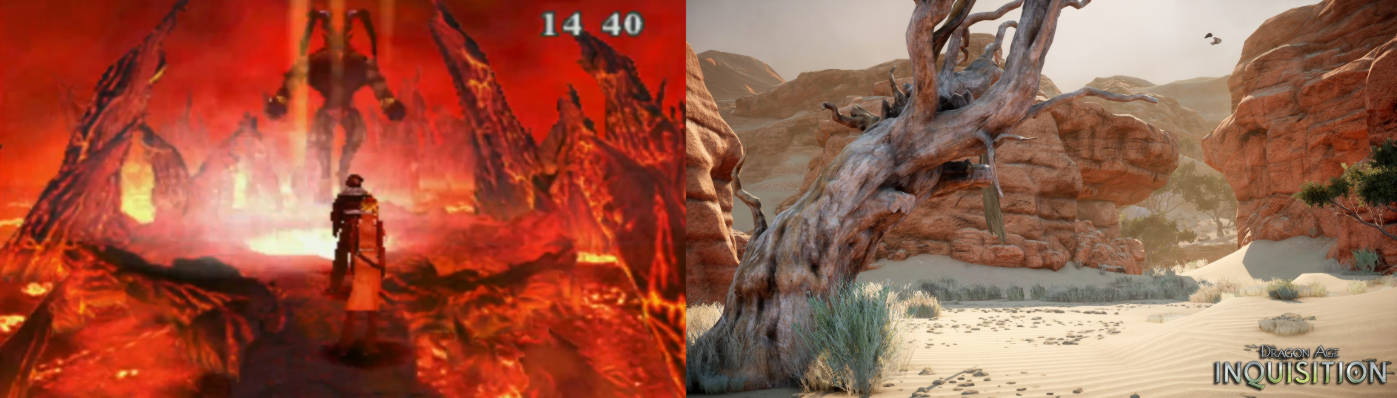
the lava or desert level,

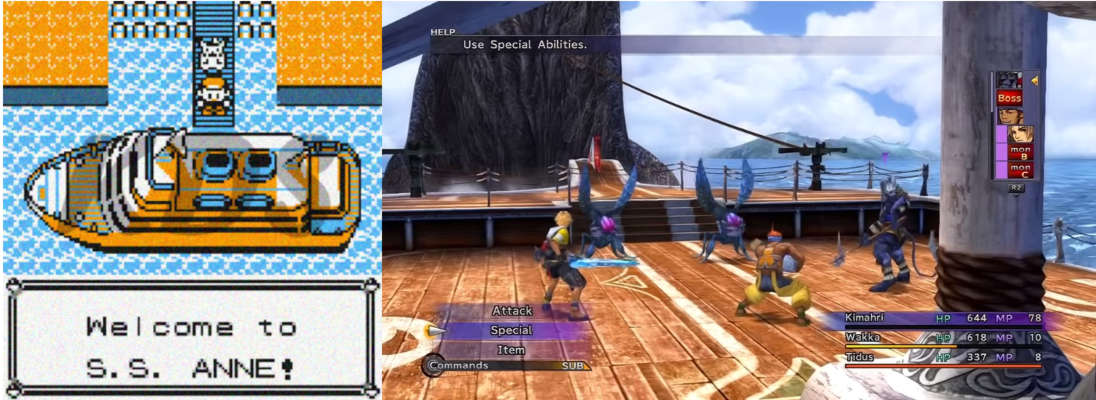
the one that has you exploring a ship (often once you’ve exhausted the continent you started on and have been instructed to Get On the Boat,

the sewer level,

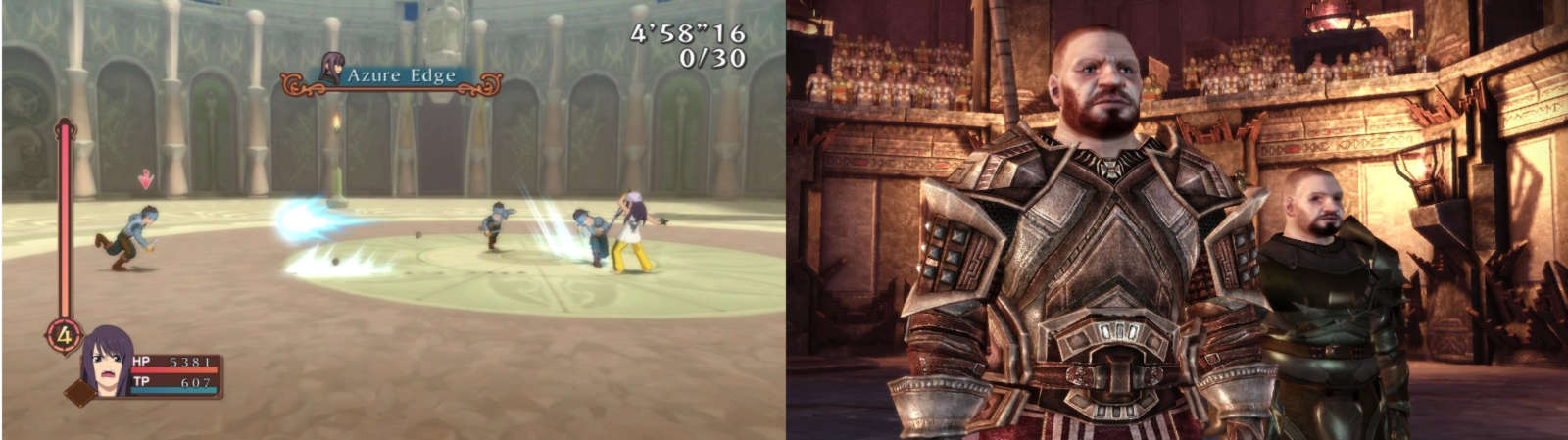
the fight-to-the-death Gladiator Level…

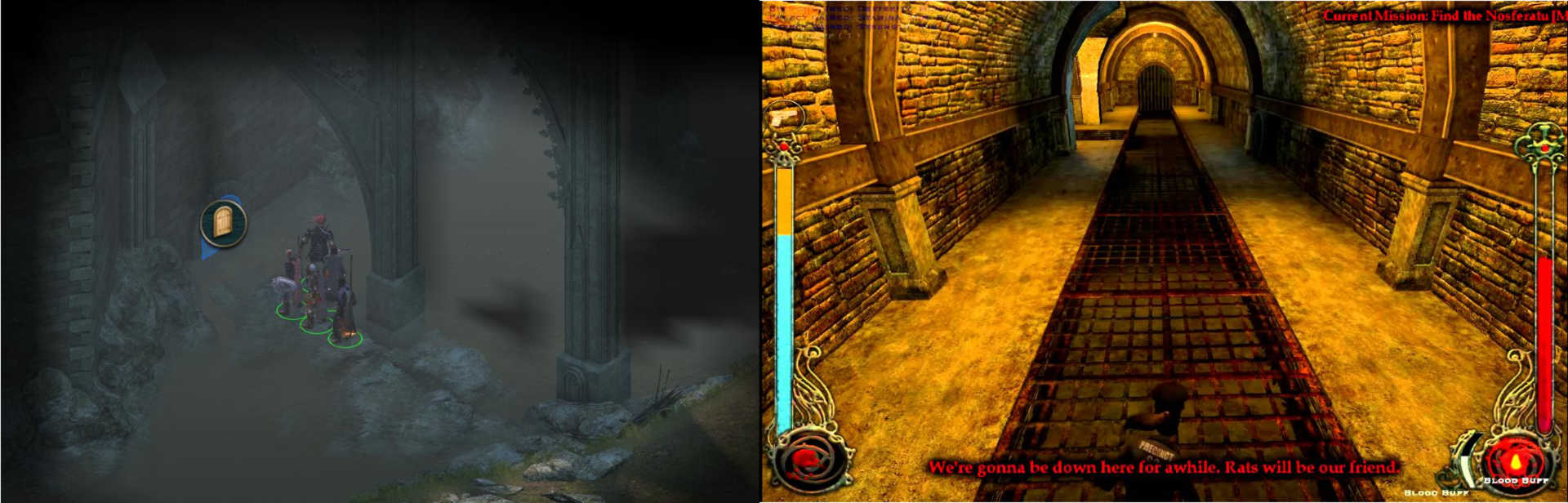
You get the idea. This scrumptious piece of pop(culture)corn centres on another (surprisingly?) common level: the one where you, your party, or both, find themselves locked up in a prison.
Unlike the aforementioned levels, which all have their own TV Tropes entry, the prison level is relegated to a subsection of the Prison Episode page, which describes the pattern thus:
A prison centred instalment in a larger work that is otherwise not about prison. It might be an episode in a serial, a sequence in a video game, or a few chapters in a book…
When this trope shows up in video games, you can expect the inventory of the player character(s) to be taken away. This results in the player having to use stealth and cunning to avoid the guards, until the hero(es) get their inventory back
TV Tropes
While it’s true that the prison level is often the setting for a stealth-based mission and provides plausible justification for stripping a player of their powerful weapons and shiny equipment, that doesn’t exhaust the potential of the prison level.
It can also be the starting zone for a game, allowing us to come to grips with the player character before we meet their comrades or providing a way to explain the player character being in a new part of the world they aren’t familiar with (if they’ve been transported from where they were arrested).

Later in the game it can provide opportunity for meaningful dialogue and relationship building with new acquaintances or old friends, as the party pulls together in a time of hardship.

It can also be used narratively to allow for a time leap where the rest of the world (and plot) moves on, but the player character (or party) stays the same.

Finally, the prison level can serve as a way of splitting up a party of adventurers, to showcase underutilised characters, play with a particular game mechanic, advance the story, or just for the lulz.[1]

Most prison levels can’t be revisited once escaped. They are generally part of the main story, rather than optional content.
An illustrative (but nowhere near exhaustive!) list follows. Let us know your favourites, including those we haven’t mentioned, on twitter/facebook/tumblr.
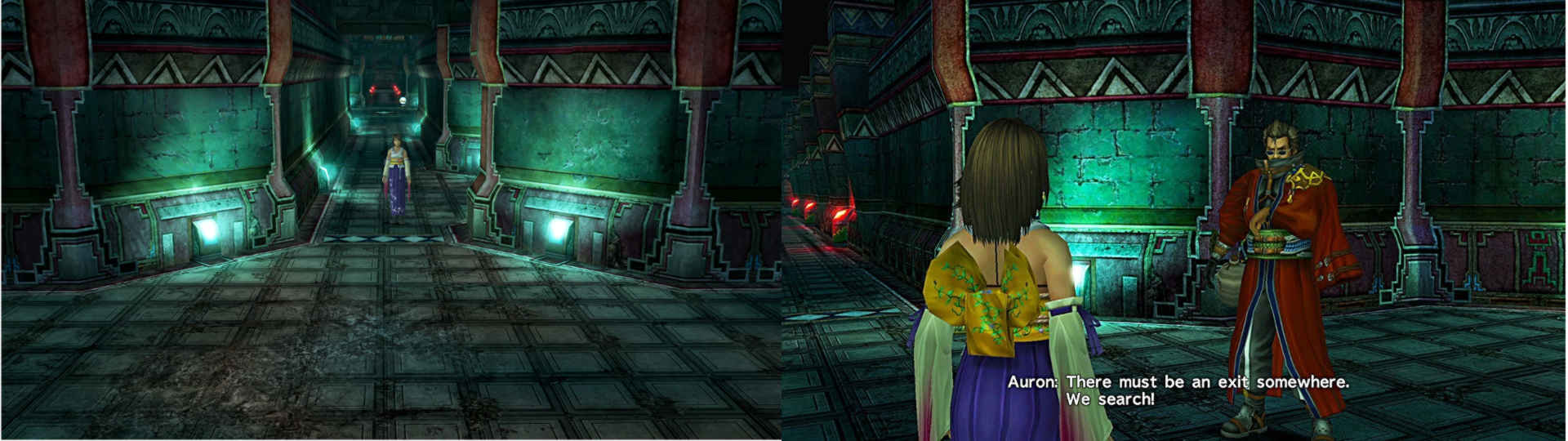
Final Fantasy X contains one of my favourite prison levels (but I’m biased, because I really love that game). Arguably it’s two levels: the party is split, and each group finds a separate way out of the Via Purifico. Tidus, Rikku and Wakka (conveniently the three characters that can swim) navigate underwater, while Yuna is - unusually - left alone (in the narrative, the other characters serve as her guardians or protectors) in a monster-infested sewer, where she rounds up the remaining allies and heads for the exit.
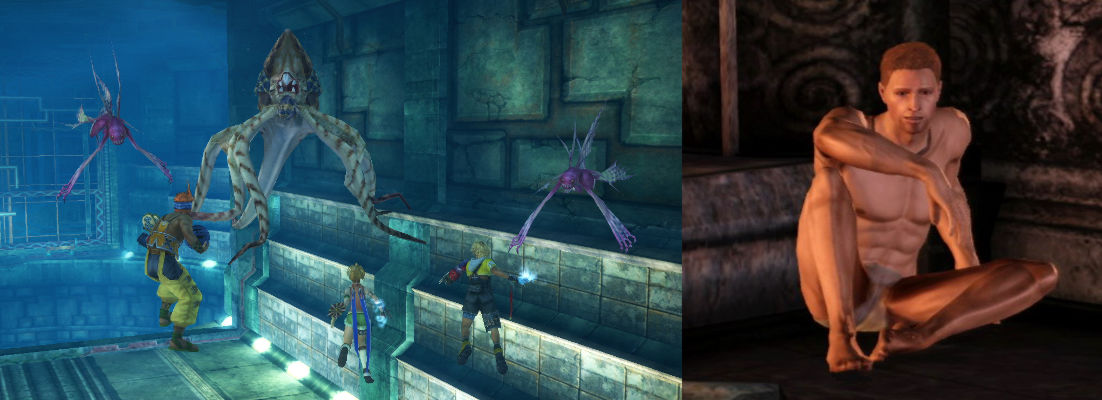
This is neither a stealth or a no-gear level, instead demonstrating the wider potential of the prison level – contrasting underwater and conventional combat, using different combinations of characters, showcasing Yuna on her own, and finally reuniting the party after a significant time apart.[2]
There are prison levels in most Final Fantasy games, but I’ll just mention one more:
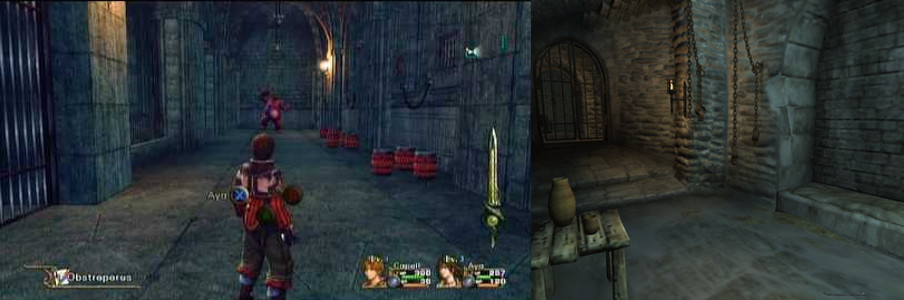
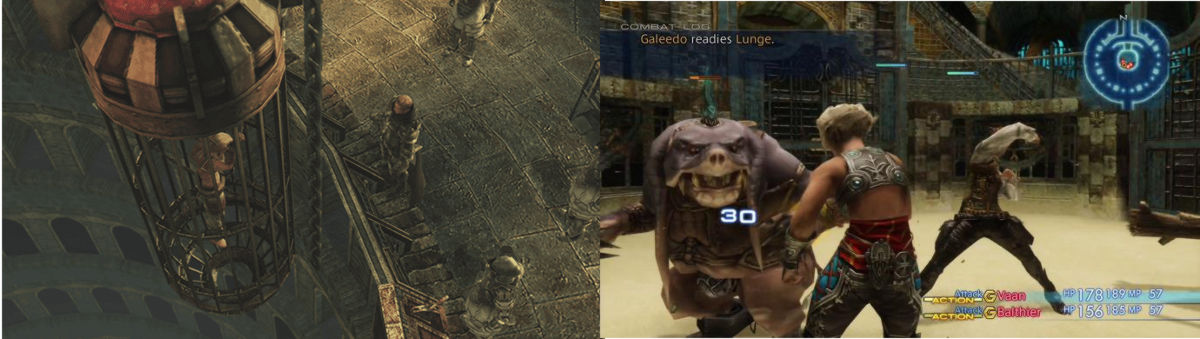
The main characters of FFXII are arrested at least three times, but the prison level I found most memorable was the Nalbina Dungeons, full of long-imprisoned NPCs waiting to die of thirst (grim, right?).
This doubles as a No Gear and Gladiator Level as the main characters get into a fight with a prison bruiser – Daguza – and his lackeys and fight bare-handed (or with the fire spell, if you’ve learned it – it’s harder to take away magic than a sword).
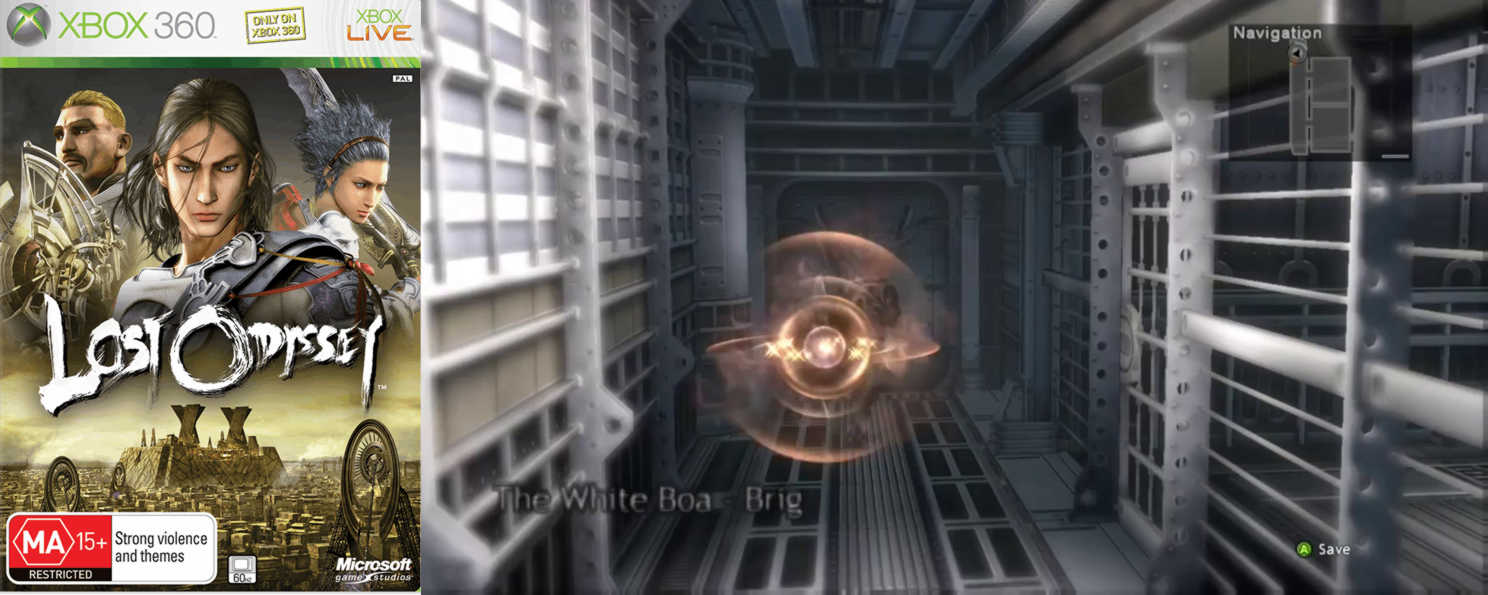
In a combination Ship/Prison level, the Lost Odyssey party are locked in the brig of the White Boa and make their escape. In a nice piece of narrative/gameplay synergy, if the players are recaptured, it doesn’t trigger a game over.[3] Instead the guard – who you convinced to let you out in the first place, having wiped his memory – will apologise and release you again.

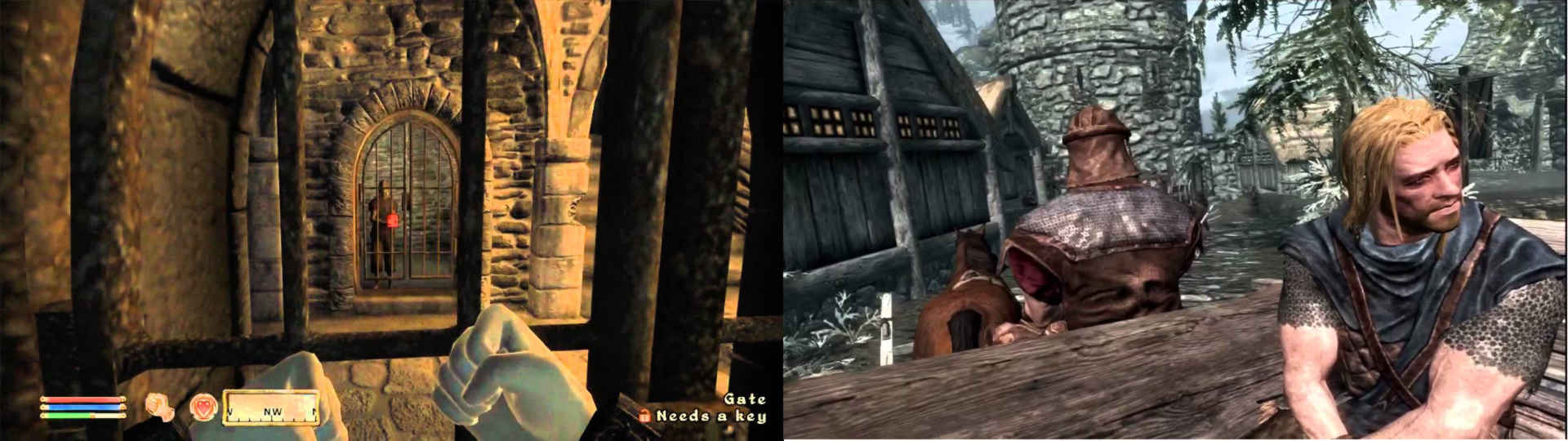
Other than Daggerfall, all of the main instalments in The Elder Scrolls series begins with the player character as a prisoner. The prison levels thus frequently double as tutorial levels.[4] Opening like this provides an in-game explanation for why the player character is unfamiliar with the basic politics and happenings in the region (which they learn at the same time as the player), as well as their lack of cool adventuring equipment.

Some redditors summed it up nicely: Why always start as a prisoner?[5]
Because it’s easy. It opens the way for the game to unfold and gives a reasonable explanation why you start without any equipment while not impeding our headcanon to what our character did prior to being captured.
Cloud_Striker
It also means that when you are freed at the start, you can do what you want. Becoming free again is a good reason for a fresh start. You don't have any old responsibilities anymore.
Captain_Jack_Falcon
It also gives a good reason why people are asking you a ton of questions. Who are you? what do you do? What did the stars look like when you where born?????
329bubby
There is an optional prison level in DAO if you fail to vanquish a particularly difficult boss in the latter stages of the game.

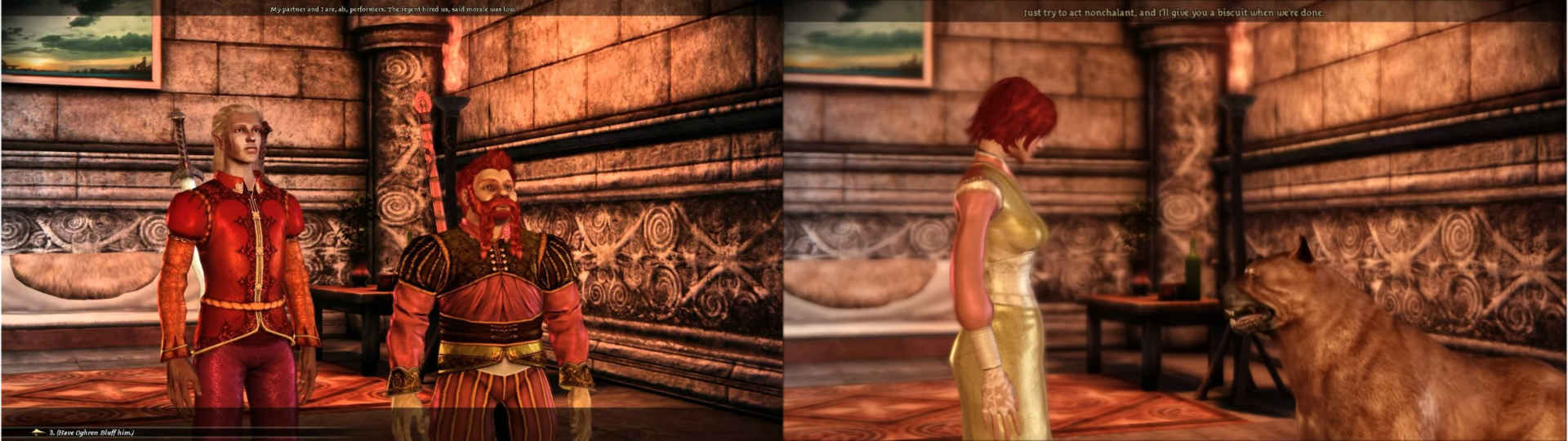
One imprisoned, you have the option of trying to escape, or waiting for two of your party members to stage a rescue attempt. The former is a fairly typical ‘No Gear Level’, temporarily stripping you of your equipment, but the latter has some of the funniest dialogue in the game. Depending on the pairing, the ruses the characters use to reach you differ, and the player gets to not only control characters they may not have directly controlled previously, but also to play with unusual pairings.

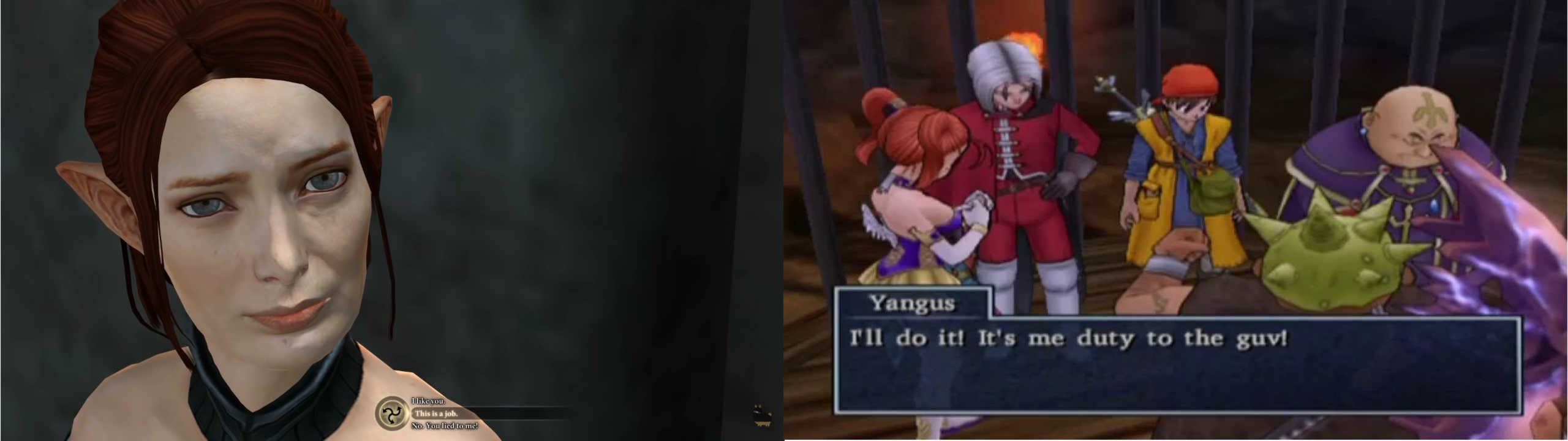
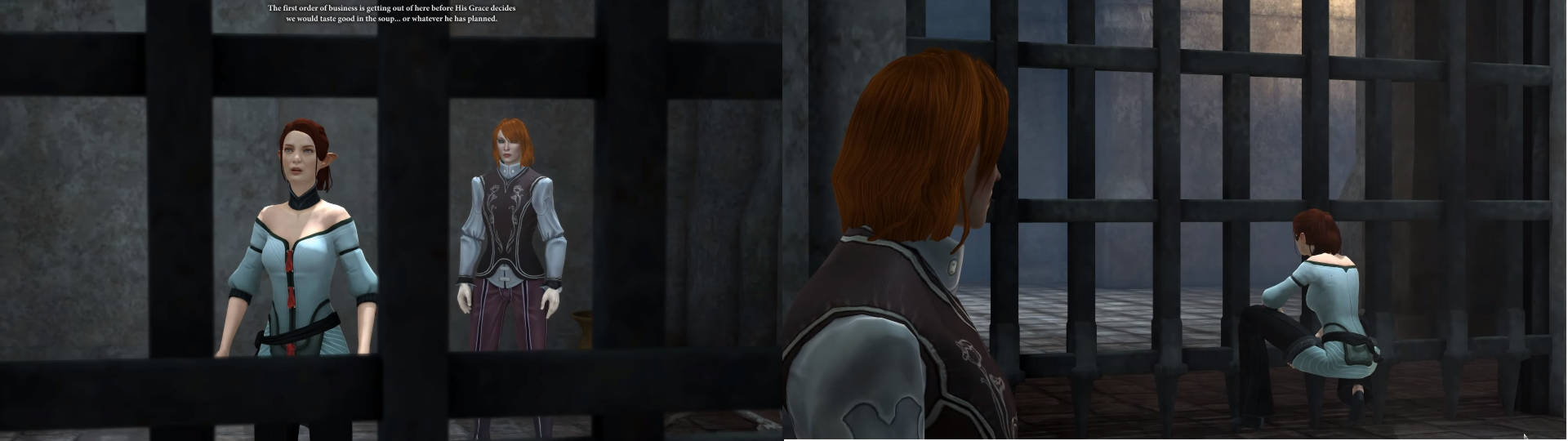
DA2 has two prison levels of note, both in DLC. In The Masked Assassin, the player character (Hawke) is imprisoned alongside new companion Tallis. In a parody of the Origins example, Hawke can insist that they wait for their companions, but the other party members have gotten lost, so Tallis facilitates their escape. The level is notable for the dialogue between Hawke and Tallis, which reveals both interesting features of her character and also the Qunari belief system.

The Legacy DLC is a more atypical example: rather than being taken prisoner in the usual sense, the party finds themselves trapped in a magical prison designed to hold something (ostensibly) bigger and badder than them.
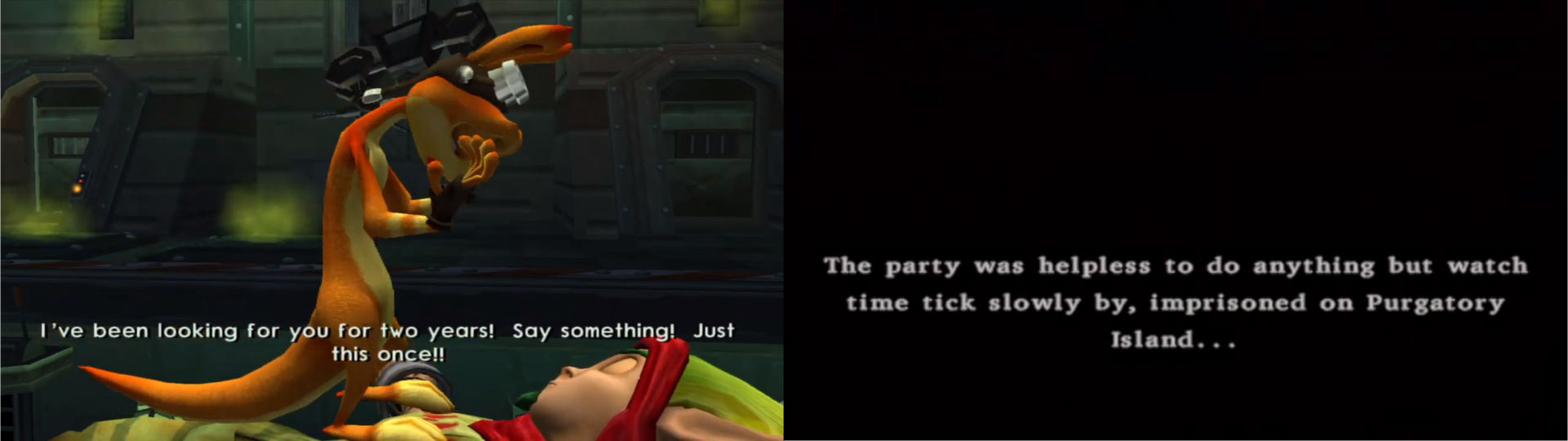
In Dragon Quest VIII, the party are falsely accused of committing a crime and sentenced for life on Purgatory Island.

It takes the characters a month to contemplate escaping, despite having all their gear, but the sequence allows for some villain redemption and party bonding.
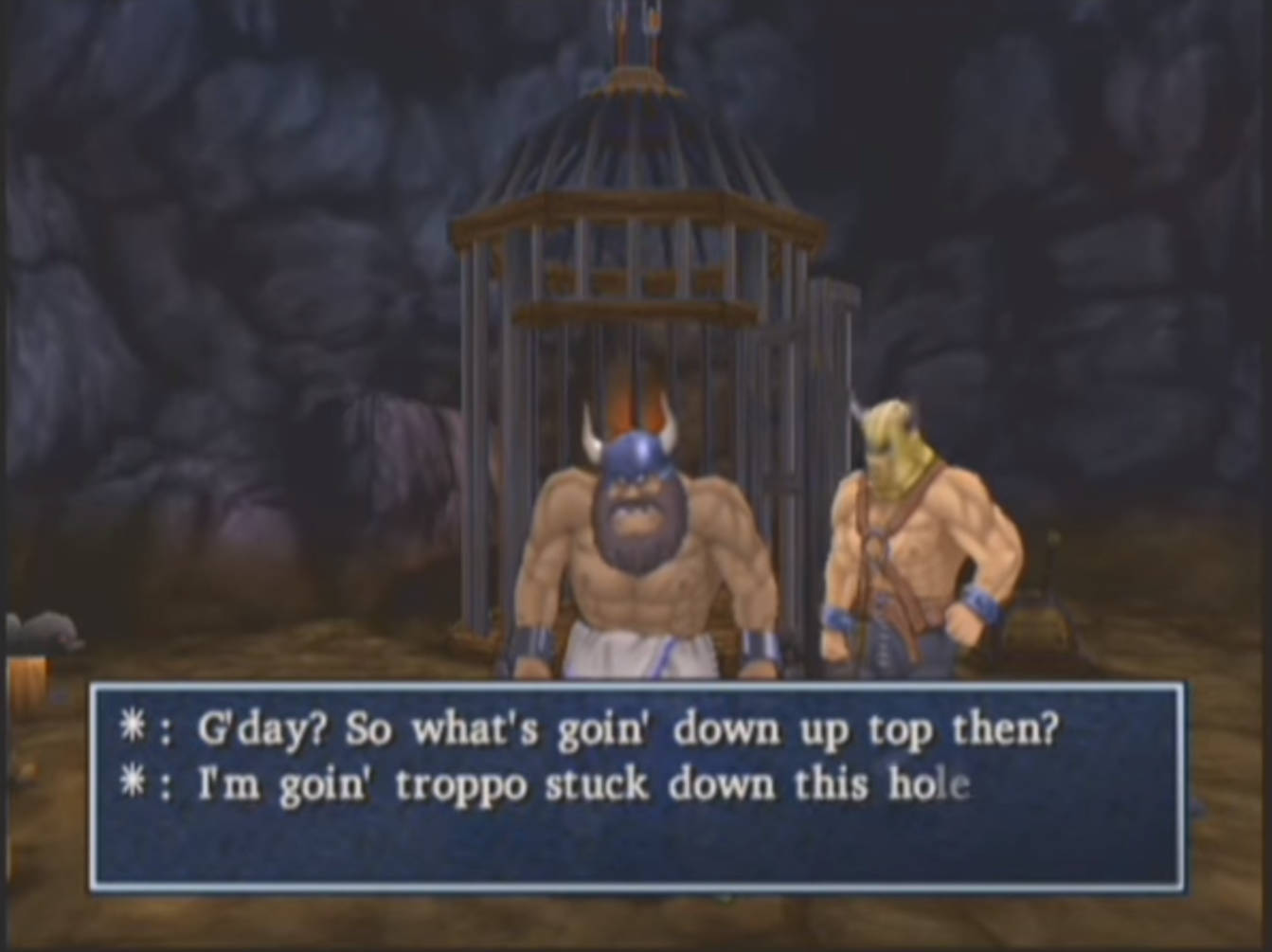
And best of all, the prison is inexplicably populated with Aussie guards.

Want to wax lyrical about other examples? Do so in the comments, or on facebook/twitter/tumblr.
[1] One of many examples where video games aren’t like real life.
[2] Remember Bikanel? Talk about a desert level.
[3] Or an unexplained repeat of the same events, over and over – I’m looking at you, Ocarina of Time. You’d think they might confiscate Link’s gear at some point.
[4] This doesn’t exhaust the prison levels in the Elder Scrolls games – some have additional instances – it’s just a nice feature to talk about!
[5] There are apparently also some in-game lore reasons for why the protagonists all begin their journeys this way – see https://www.reddit.com/r/skyrim/comments/3v9kai/why_we_always_starting_as_a_prisoner/ for more information.
The Modern Scots era was a period of enterprise and radical tumult, both for Scotland and her languages, encompassing the Treaty of Union, the Jacobite Rebellion, and the advent and diffusion of Scottish Standard English (the not-at-all embarrassing Scottish equivalent of RP). Whilst the Union of Parliaments in 1707 is often regarded as hastening the demise of the Scots language, the ensuing protests (read: shit-storm) produced a resurgence in Scots literature: ballads and oral tales and songs were revisited, revitalised and committed to paper, many for the first time. Despite this literary response, though, the political and social centre of gravity had inveterately shifted south and the century would confirm the Scots
The influence of an English-speaking readership would be critical in the development of the Scots language’s fortunes in the 18th and 19th Centuries: the advent of literacy[1], wherein Scots would be taught English linguistics norms, would result in the use of Anglicised <oo> spelling to represent /u/ in words such as hoose, moose and aboot, and the exponential erosion of Scots lexis: the departure south of Scotland’s premier political institutions limited the capacity of Scots to innovate lexically, particularly for scientific or specialist terms – there being, for instance, no specifically Scots term for evolution. Or felching. (Editor's note for the unwary: please don't google 'felching'.)

Most iconic, perhaps, of the official downfall of Scots was the introduction of the apologetic apostrophe: the item of punctuation signifying ‘missing’ letters in Scots words such as no’ (not) and fu’ (full). First used by the notable antiquarian, Allan Ramsay (1686-1758), the apologetic apostrophe was a marketing strategy by the Scottish literati, designed to make the language accessible to a swelling, middle-class English-speaking readership whilst retaining, ostensibly, the perception of authenticity. For example, observe below the opening lines of two versions of the story of Thomas the Rhymer, the first by Anna Gordon (1747-1810) and the second by Walter Scott (1771-1832):
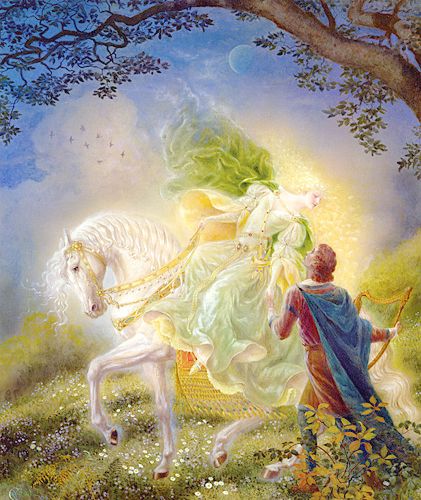
True Thomas lay oer yon’d grassy bank
And he beheld a Ladie gay
A Ladie that was brisk and bold
Come riding o’er the fernie brae
Her skirt was of the grass green silk
Her mantle of the velvet fine
At ilka tett of her horses mane
Hung fifty silver bells and nine
Gordon, 2011: lines 1-8
True Thomas lay on Huntlie bank;
A ferlie he spied wi’ his e’e:
And there he saw a ladye bright,
Come riding down by the Eildon Tree.
Her shirt was o’ the grass-green silk,
Her mantle o’ the velvet fine;
At ilka tett of her horse’s mane,
Hang fifty siller bells and nine.
Scott, 1812: lines 1-8
Aside from obvious differences in orthography, structure and punctuation (to be revisited in a later article), note the absence of apologetic apostrophes in Gordon’s version and their introduction in Scott’s in line 2 (the latter’s version being inspired by the former’s). Unlike Scott, Gordon wrote down her version of the ballad purely for the benefit of various antiquarian scholars and writers. Scott, however, produced his version in his ballad collection, The Minstrelsy, whose ensuing popularity with English-speaking audiences would make him very rich indeed. This strategy to improve the marketability of Scottish prose and poetry would, according to Corbett, Mclure et al, have “the unfortunate effect of suggesting that Broad Scots was not a separate language system, but rather a divergent and inferior form of English” (2003: 13). Of course, as the Mongongo nut is salvaged from even the most impenetrable pile of steaming elephant shit, so too was there a redeeming factor to this affair. As a result of the uptake of textual transmissions of Scots works by the antiquarians and other interested parties, “from the eighteenth century onwards there is an exponential growth in the variety of literary forms in which Scots is used” (Bann & Corbett, 2015: 67). So that’s nice.
It’s important to differentiate between an apologetic apostrophe and a simple contraction – something this linguistics podcast fails to do. They argue that contracting over to o’er is an apologetic apostrophe – which is incorrect. Crack out the pitchforks and dismiss their lies! Possibly burn their holdings. Leer at their cat and thus make him uncomfortable… Contracting over to o’er is a common method, evident throughout the history of English, for shoehorning bi- (and sometimes tri-) syllabic words into monosyllabic varieties for the purposes of metrical rhythm e.g. if you’re writing to a meter of iambic tetrameter (four feet of dee-dum) but have nine syllables, that just won’t do. What they’re referencing is an eliding apostrophe – NOT an apologetic one. Be vigilant and stay safe, kids.
Someone really ought to write a history of the apologetic apostrophe – indeed, a detailed history of the apostrophe itself would be fascinating (fuck you, it would be). I say this only because, in the course of the last three hundred years, the apologetic apostrophe went through a period of radical evolution, transforming from a linguistic unit of accessibility and into a literary device, and the details of this mutation are unclear. By what manner (and media) did the apologetic apostrophe diffuse? At what pace? Was there more than a single country of diffusive origin, or is this a singular Scottish innovation? Or, one wonders aghast, is the literary device an independent invention, originating independently from its linguistic cousin? If you don’t find out, I’ll have to do the donkey work and I tire so very easily.
The influence of an English-speaking readership would be critical in the development of the Scots language’s fortunes in the 18th and 19th Centuries.
Despite the fug of terra incognita, the apologetic apostrophe made the transition from linguistic feature to literary device and, as with all things literary, the function of the apologetic apostrophe in fiction seems less concerned with accessibility than it is expressing a characteristic of its respective speaker. Question: recall, if you can, instances of the apologetic apostrophe in novels, poems, video games etc. What was the nature of the speaker? An august elf? A sagacious wizard? A young hero, emerging into adulthood and struggling to not masturbate for 500 pages? You’re fuckin’ right it wisnae. The apologetic apostrophe in literature has (almost) become universally applied as part of a wider characterising apparatus wherein supporting characters of certain personalities, such as the brutish minion, the sweet-but-simple friend, are given non-standard dialects – indicated by apologetic apostrophes – to indicate their natures. Observe the two following examples:
“An’ here’s Harry!” exclaims Hagrid, when he meets the novel’s protagonist in chapter four, continuing, “Las’ time I saw you, you was only a baby” (Rowling, 1997: 39). Note the apologetic apostrophes in the opening words of each sentence and then consider Hagrid’s nature: a good-natured groundskeeper, loyal but naïve, rustic, comedic (crucially unintentionally), and magically-impotent. This echoes historical examples – for instance in The Private Memoirs and Confessions of a Justified Sinner, the character of John Barnet is a reverend’s manservant: perceptive but disposable. Hinting at his suspicions of the protagonist’s dark heart, he says: “They find ma bits o’ gibes come hame to their hearts wi’ a kind o’ yerk, an’ that gars them wince” (Hogg, 2010: 80). Of course, whatever perceptive abilities he possesses are rendered ineffectual by his non-standard dialect – his efforts to thwart evil are ignored.

As with Hogg’s prose in the early 19th Century, Rowling’s use of the apologetic apostrophe is part of a wider nexus of sociolinguistic and phonaesthetic tropes: pioneered in Scots literature (for the same reasons as the apologetic apostrophe), it became, and continues to be, a popular device by authors to write narrative in standard English and contain non-standard dialectal speech within dialogue.
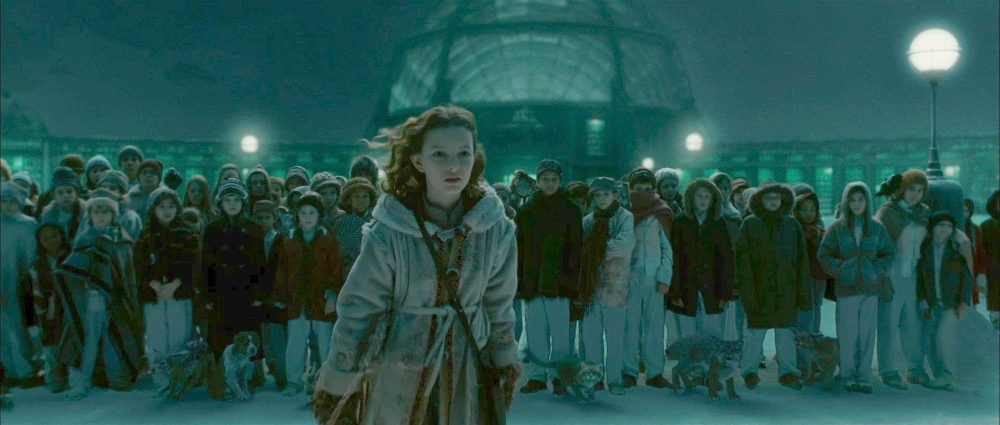
It’s still less common for a speaker in fiction (and particularly the fantasy genre) of a non-standard dialect to be written as the protagonist of any literary venture, but one such instance is Lyra Belacqua: the fearsome, bidialectal protagonist of Pullman’s (utterly magnificent) The Northern Lights (also known, unnecessarily, as The Golden Compass). Unlike Hagrid, then, where Rowling’s use of the apologetic apostrophe is arguably solely literary to convince us of the stereotypical qualities that attend its use (see also the driver of the Knight Bus, Stan – Choo lookin’ at? – Shunpike), Pullman deploys the apologetic apostrophe in order to reflect the communities of practice that Lyra moves in, a phenomenon explained by Milroy as “the closer an individual’s network ties are with his local community, the closer his language approximates to localised vernacular norms” (1980: 175). In essence, Lyra uses standard English variants whenever speaking to an authoritative audience, such as her father, Lord Asriel, and non-standard variants when speaking to peers.

Observe this passage from chapter 2 between Lyra and Lord Asriel:
“Did they vote to give you money?” she said, sleepily.
“Yes.”
“What’s Dust?” she said, struggling to stand up after having been cramped for so long.
“Nothing to do with you.”
“It is to do with me,” she said, “If you wanted me to be a spy in the wardrobe you ought to tell me what I’m spying about. Can I see the man’s head?”
Pullman, 1995: 28-29
Now consider this passage between Lyra and the other children of Oxford:
“The Gobblers,” she said. “En’t you heard of the Gobblers?”
…
“Gobblers,” said Lyra’s acquaintance, whose name was Dick. “It’s stupid. These stupid Gyptians, they pick up all kinds of stupid ideas.”
“They said there was Gobblers in Banbury a couple of weeks ago. They probably come to Oxford now to get kids from us. It must’ve been them what got Jessie.”
“…They en’t real, Gobblers. Just a story.”
“They are!” Lyra said, “The Gyptians seen ‘em!”
Pullman, 1995: 60
The Lyra engaging with the other children of Oxford would never use ought; likewise, the Lyra attendant to her father carefully avoids non-standard expressions requiring the authorial illumination of an apologetic apostrophe such as “en’t” or “’em.” Whilst Pullman’s use of the apologetic apostrophe is arguably somewhat more sophisticated than Rowling’s, functioning as an indicator of the complex linguistic landscapes we all navigate, and Lyra is certainly less of a caricature than Hagrid, the use of the apologetic apostrophe in both texts remains bound to its original mission: decorating non-standard speech for the benefit of standard speakers (or at least speakers with an understanding of standard English as the default). It ought to be said there’s nothing inherently wrong with this – all languages have prestige forms – but it is important we’re aware of its function and impact. For science.

There are many souls the world over for whom language is a political battleground, often attended by issues of language revival. Such a scrimmage is (and has been for some time) being waged in Scotland. Not being in the business of language revival myself, suffice to say the situation concerns attempts to rejuvenate a stagnant Scots language, presumably with ultimate goal being to establish it once again as a prestige form within Scottish society. The role of apologetic apostrophe has been integral within this movement and its exorcism from textual varieties of Scots has become a socio-political act. Minutes from the meeting of the Makar’s Club in 1947 simples reads: “Apostrophe’s to be discouraged.” The website of the British Ordnance Survey, a repository of maps and guide to outdoor Britain, writes: “In earlier writing an apostrophe will be found in such words, for example, ha’, to indicate the loss of ll, but this is no longer acceptable.” The banishment of the apologetic apostrophe was a key tenet of Lallans Scots, the synthetic variety of the language created in the early 20th Century by poets such as Hugh MacDiarmid to supply Scotland with a unified national language. Whilst one might describe the idea of Lallans as an ongoing project, it has produced some rather beautiful lexis e.g. watergaw: “an imperfect or fragmentary rainbow” (Macleod, 1999: 59).
It’s still less common for a speaker in fiction (and particularly the fantasy genre) of a non-standard dialect to be written as the protagonist…
The elision of the apologetic apostrophe can also be interpreted as an important political statement, particular concerning notions of identity, in other varieties of English.

A notable example is in the poetry of the much-celebrated (and rightly so) writer and artist, Louise Bennett (pictured above). Her poem, Yuh Nephew Sue, is written in unfettered Jamaican English, as shown in its opening lines:
Aunt Tama, dear, me sad fi hear
How storm wreck Jackass Tung;
But wus of all, yuh one deggeh
Coaknut tree tumble dung!
Las week dem had a meetin fi all De coaknut growers what
Lose coaknut tree eena de storm, So me was eena dat.
Bennet, 2016: lines 1-6
In a world where social issues inevitably intersect with one another, reifying one’s identity through language is an understandable act, and thus the elision of the apologetic apostrophe an understandable protest – and in the 21st Century, it can be profoundly post-colonial. Socio-politics aside, the deconstruction of the apologetic apostrophe is perhaps an inevitable outcome of language evolution: change and deviation, as it does, becoming subsumed by systemic regulation.
Given its current trajectory, it’s likely the apologetic apostrophe will vanish genre-by-genre, beginning with, one imagines, non-fiction and its dissolution eventually migrating throughout the entirety of fiction. The apologetic apostrophe, however, is a fascinating example of how a single unit of punctuation can reach across linguistics, literature, history and politics, and in that regard we ought to admire the pluck of the little fellow.
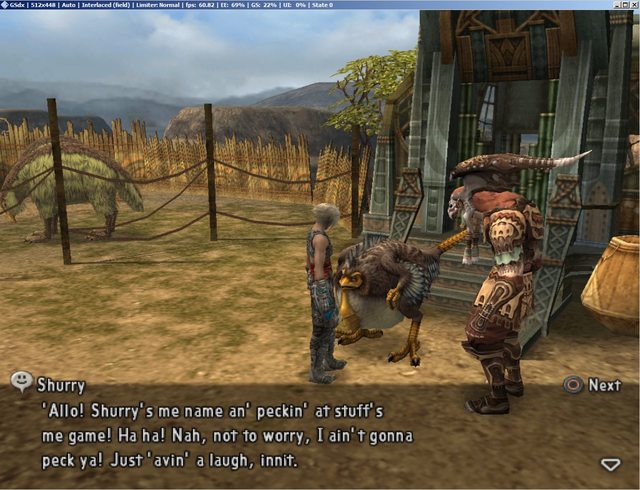
If your whistle has been moistened by this article, you might consider ‘It’s glo/t/al stop, not glo/ʔ/al stop!’ Or don’t – I’m not paid to do this so my attitude to your education is, at best, apathetic. As a parting gift, however, do enjoy this screenshot of a cockney cockatrice.

[1] As an interesting aside, there are parallels across the world and throughout history of oral cultures suffering their demise at the hands of literacy. A particularly rich exploration of this can be found in the novels of Chinua Achebe such as Things Fall Apart and Arrow of God, both of which explore the impact of European civilisation on the Igbo culture (now part of present-day Nigeria).
Bennett, L. (2016), Yuh Nephew Sue, Retrieved from: http://jamaica-gleaner.com/article/art-leisure/20160911/poems-0
Corbett, J., McClure, J. & Stuart-Smith, J. (2003), A Brief History of Scots, The Edinburgh Companion to Scots, ed. Corbett, McClure & Stuart-Smith, (Edinburgh: Edinburgh University Press).
Hogg, J. (2010), The Private Memoirs and Confessions of a Justified Sinner, (Oxford: Oxford University Press).
Macleod, I. (1999), Scots Thesaurus, (Edinburgh: Polygon).
Milroy, L. (1980), Language and Social Networks, (Baltimore: University of Park Press).
Rowling, J. (1997), Harry Potter and the Philosopher’s Stone, (London: Bloomsbury).
Pullman, P. (1998), The Northern Lights, (London: Scholastic).

My work is inspired by the likes of James Paul Gee, Kurt Squire and the late Seymour Papert, and focuses primarily on difficult-to-teach transferable skills (sometimes referred to as ‘graduate attributes’ by universities such as mine) rather than the transfer of knowledge. These skills include communication, collaboration, adaptability, critical thinking and resourcefulness: skills which, I argue, are required in abundance in certain commercial video games.
There are significantly improved gains on the measures of communication, resourcefulness and adaptability for the game-playing group versus the control...
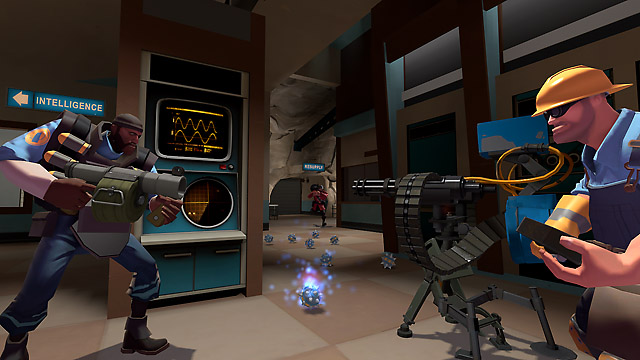
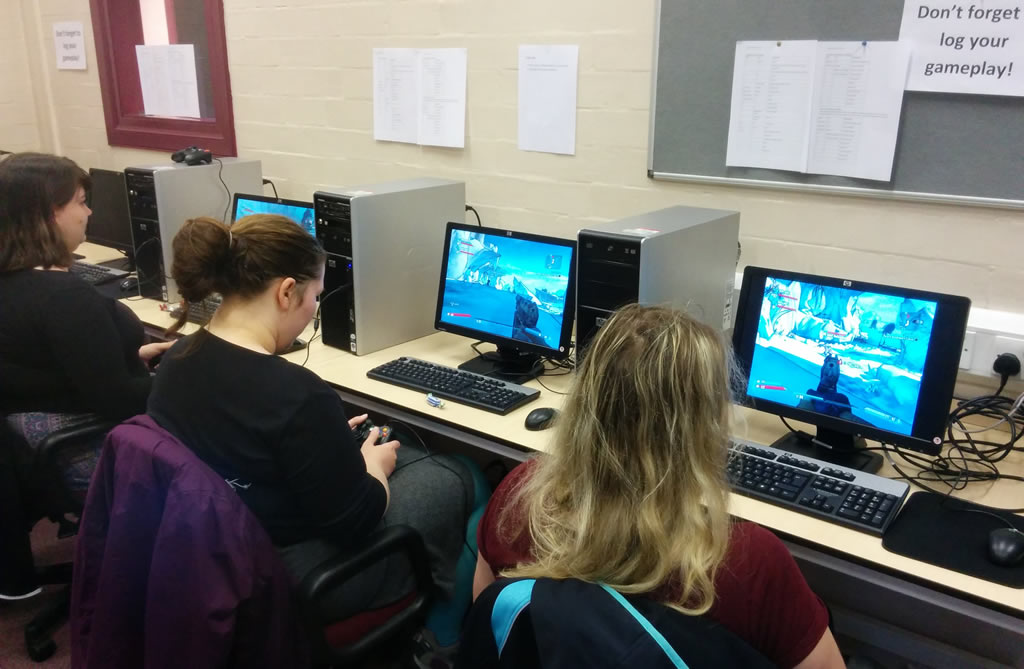
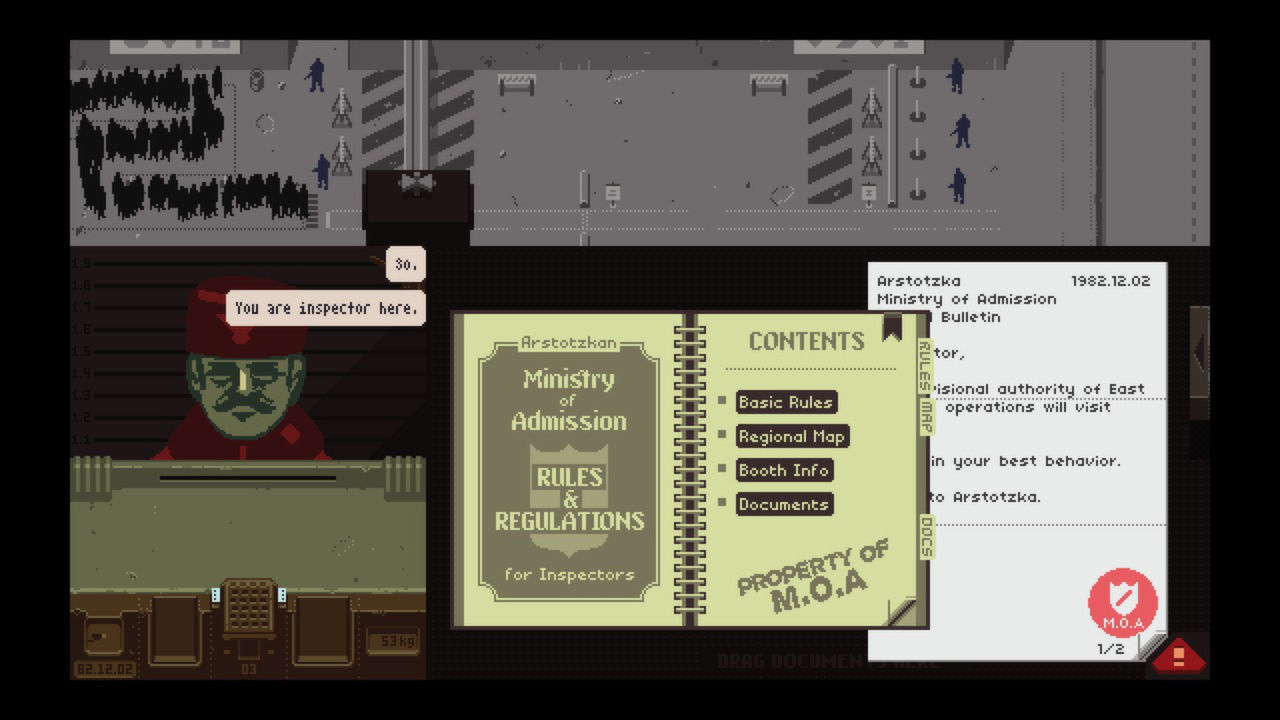
To test this idea, I recruited undergraduate students to take part in a study. Half the students were randomly assigned to a group that would take a battery of psychometric tests to measure their communication skill, adaptability and resourcefulness, then play selected video games for a semester and take the tests again. The other half were assigned to a control group, and asked only to take the tests at the beginning and end of the semester. The games played included multiplayer shooters such as Team Fortress 2 and Borderlands 2, recent indie hits Gone Home and Papers, Please, old-school strategy title Warcraft III, and the ubiquitous Minecraft. Participants played a minimum of two hours of each game before moving on to the next, and we were fortunate enough to have a dedicated computer lab on campus that students could drop into between classes.

Looking at the test results from the beginning of the semester and the end, there are significantly improved gains on the measures of communication, resourcefulness and adaptability for the game-playing group versus the control (differences of between 0.9 and 1.15 standard deviations in test scores, stats fans!). 95% confidence intervals calculated for the difference between mean scores for the control and game-playing groups did not cross zero, suggesting that playing video games is beneficial to the wider student population.

The study is currently being written up for publication, and I hope to collect more data to support these initial findings but, for now, those of us who have been playing these games for three decades or more can reasonably claim that it wasn’t such a terrible waste of time after all…
We’re back! We survived! For those of you not in the know, those exclamations are in relation to Nine Worlds Geek Fest, which took place last weekend, and was fabulous.
The Doctor ran four sessions:
The Doctor was joined by The Master, Alice Bell, Daniel Nye Griffiths and Hazel Monforton to discuss the deeper side of Dragon Age, including its treatment of sexuality, gender, class, religion and ethics. The populous audience made a series of astute observations and asked fascinating questions, and a merry time was had.
This whole panel is so good I might cry #DragonPhil
— Anders defense squad (@HightownFunk) ;August 12, 2016
Taking a little time out before next session. Thanks to all involved in #dragonphil was a really engaging panel. #NineWorlds
— Liss (@unsteadyfooting) August 12, 2016
If you missed it, or want more, never fear: there will be Dragon Age-related posts on the site soon, including interviews with Hazel and Daniel.
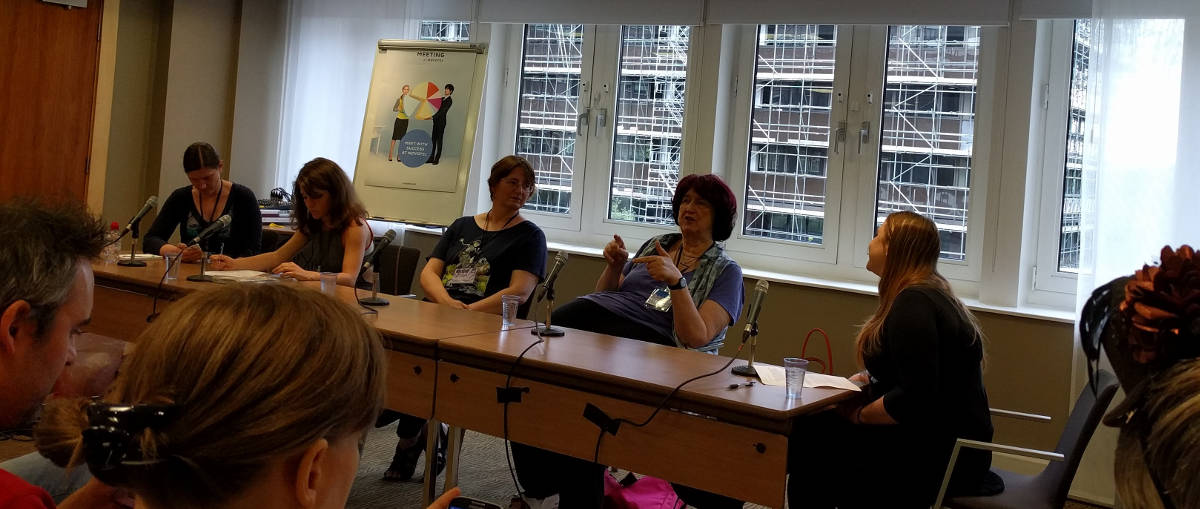
In this panel, BAFTA-award winning TV writer Debbie Moon, Filmmaker Sarah Barker, comics expert and academic Jude Roberts, and writer and critic Roz Kaveney joined the Doctor to critically engage with feminist themes in Netflix's Jessica Jones. Questions considered included: what makes a strong female character, and muscles aside, does Jessica fit the bill? Is she a hero? How does the show handle intersectionality, and what could it do better? How does the TV show compare to the comics?

The Doctor got to wax lyrical about her favourite subject - time travel - and to her surprise and delight it was one of the most popular events at Nine Worlds! The focus: what a philosopher thinks makes good time travel fiction, a field guide of sorts for creators and consumers alike. Find out more in the Epicurean Cure's ongoing time travel series.
Really excellent session by @EpicureanCure on philosophy in time travel films. Bill & Ted's Excellent Adventure is the masterclass!
— Unsung Stories (@UnsungTweets) August 13, 2016
Just walked out of the best panel at #NineWorlds (so far). Time travel in fiction by @EpicureanCure. Fascinating! pic.twitter.com/OPvi9X66UC
— Lauren O'Callaghan (@LaurenHollyOC) August 13, 2016
Brilliant time travel talk @London_Geekfest
I could listen to @EpicureanCure talk about this all day #NineWorlds pic.twitter.com/N0T4EJo9QC
— Alice Reeves (@Alice_Reeves) August 13, 2016
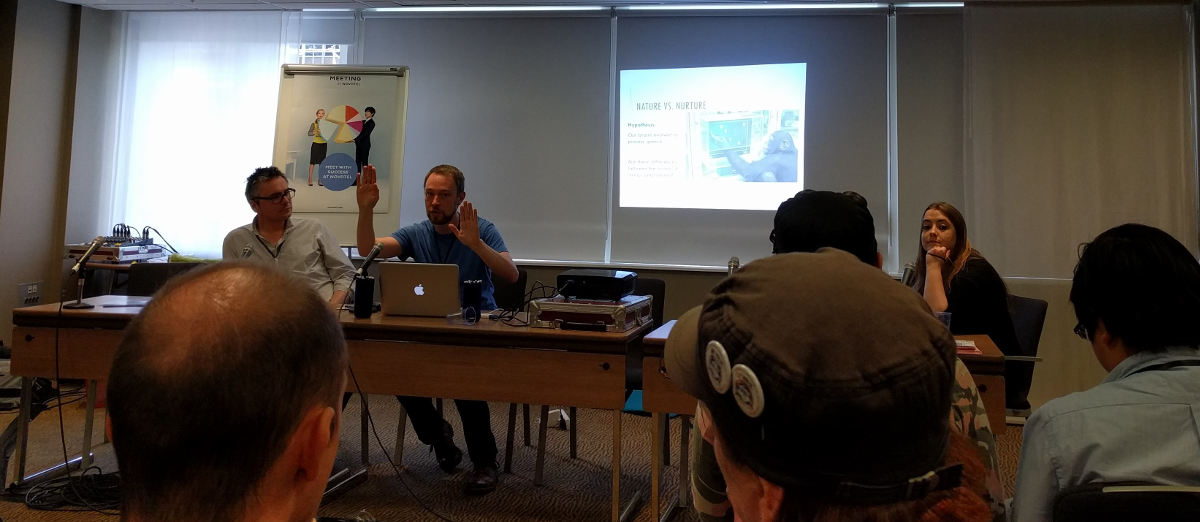
Our resident philosopher was joined by evolutionary linguist Sean Roberts (soon to be from Bristol, but currently the Netherlands) and Game Studies ‘Person’ Matt Barr (University of Glasgow). Each gave a short talk on their research and the potential of video games to shape, inform and improve academic practice. Academics often theorise about video games, but this was a chance for video games to talk back.

The trio spoke about what we can learn about so-called ‘folk intuitions’ from the tropes in games, how video games impact learning, and what Minecraft and chimpanzees (not together, sadly, no chimps played Minecraft) can tell us about the evolution of language and cognition. You can read about the latter here. If you’re interested in more events like this, consider checking out the new Relating Philosphy & Games (RPG) series, which you can find out more about on facebook and twitter.
If you missed any of the above, or would like further info, let us know. And if you’d like to host similar events, or are running something we could usefully be a part of, do give us a shout.
The Epicurean Cure team also had the pleasure of attending other people’s sessions, including the splendid Catherine Sangster – head of pronunciation at the Oxford English Dictionary – talking about words from geek culture that are making their way into the dictionary; Classicist Nick Lowe’s fabulous insights into historical fiction and fan culture; and a fascinating panel on gaming and neurodiversity, including some superb development tips:
Another dev tip from #neurogaming: make cut scenes easily skippable (to minimise triggering) - digital equivalent of the tabletop X-card.
— Epicurean Cure (@EpicureanCure) August 12, 2016
(As you can see, we did a lot of our interacting via twitter, so do follow us there or on facebook for more regular updates).
One last thing on the Nine Worlds front: we’ll be announcing the winner of our microfiction contest on Monday 21st August, so stay tuned for that!

Finally, what to expect in the coming weeks: interviews from some excellent folks (both academics and fiction creators, sometimes both at once!), new instalments in our existing time travel and foreknowledge series, and more reviews. If there’s anything in particular you’re hoping to see, do comment below. And, as always, if you’re interested in getting involved, there are plenty of ways to participate.
High eight (tentacles are better than fingers, y’know),
Tetra
I felt a sense of pain when I beheld
The silent trees, and saw the intruding sky.
Then, dearest Maiden, move along these shades
In gentleness of heart; with gentle hand
Touch – for there is a spirit in the woods.
William Wordsworth, Nutting (1800)
With not a little reservation, I’ll admit: previously, I’ve never liked platform games. The rigid, linear trajectory always struck me as tyrannical; an autocratic device that purposefully dispensed with meaningful story and character development in favour of a tightly-controlled ‘bonus’ economy, the player conditioned from the game’s inception to be satisfied, even sedated, by the promise of scores-without-ceilings, base power-ups dosing ephemeral advantages, and a trope-drenched plot dotted with Manichean characters, each of whom are about as charismatic as a recycled tampon. Further, and I regard this as a foundational gaming principle to which I fervently subscribe, if there’s no opportunity to creep on a broody elf or dashing mage, I’m really not interested.

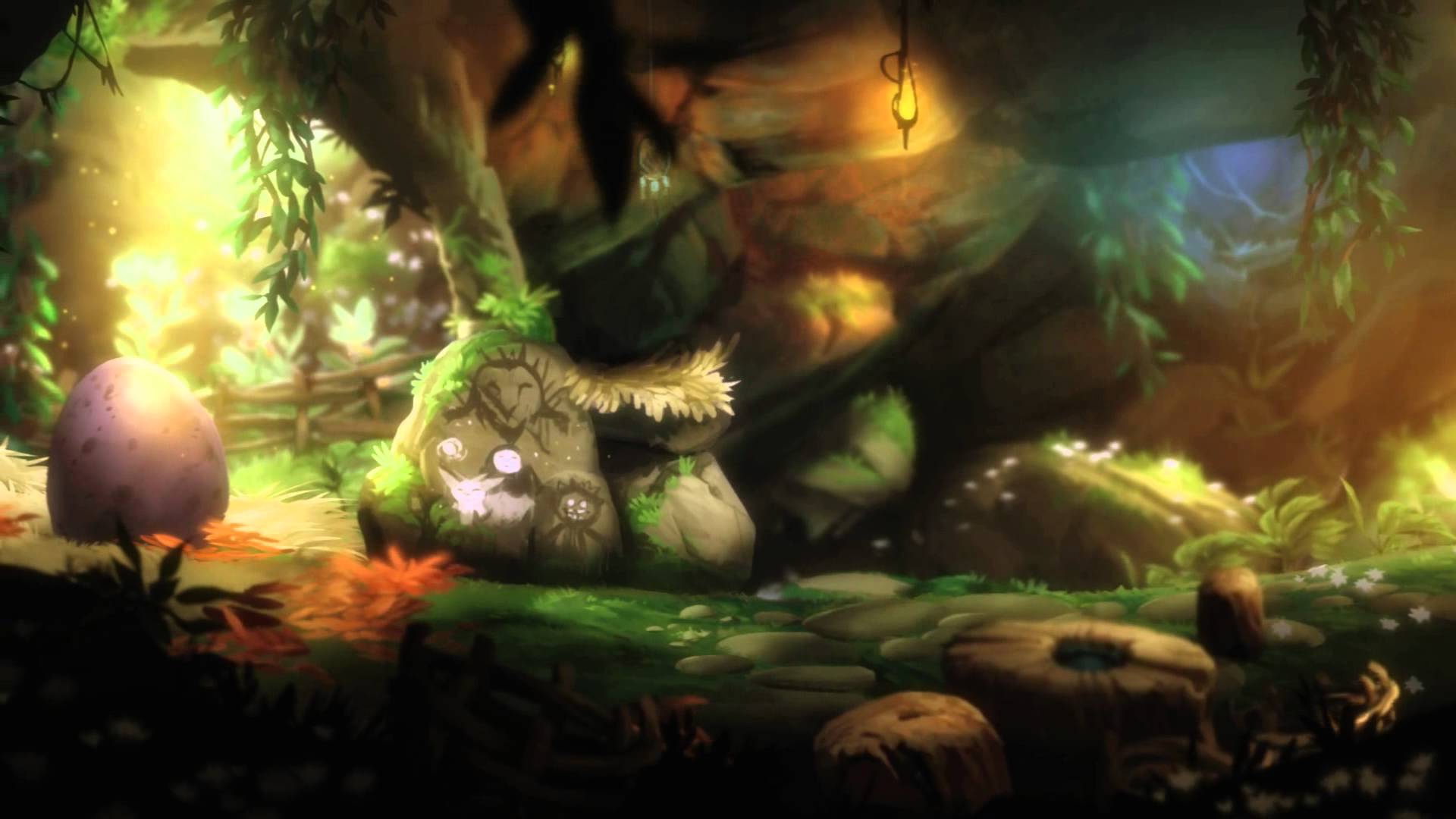
So when I chanced upon an image of Ori and the Blind Forest, I’m not really sure why I decided to buy it. Likely it’s the result of my prizing aesthetic quality above all else (life is infinitely more negotiable, if a little less rich, when you estimate the merits of a prospective friendship based not on personal compatibility but on how long you’ll be able to tolerate their looking like an animated bin-bag). The bioluminescent landscape, the character design, the obvious depth of Naru and Ori’s connection: it’s disarming, and immediately brought to life by the exquisitely haunting opening soundtrack, all of which inspired the thought, quite unbidden: “This game is going to be baws-to-the-wall awesome.”
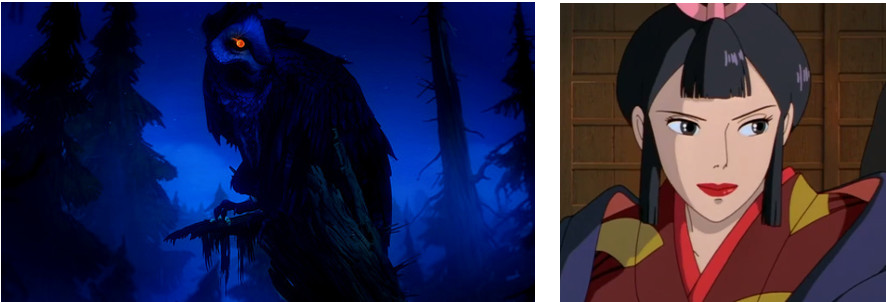
The story itself recalls the abiding trope of the endangered forest, destabilised and unbalanced, its peril engineered by an external, often apathetic force. Throughout the game, I was reminded of Princess Mononoke, and in particular the kinship in motive between Kuro, the bereft antagonist, and Lady Eboshi. Both fight against a forest indifferent or opposed to their wellbeing, and both intend to retaliate with fatal finality, regardless of consequence. This is what stayed with me – long after the credits were done and I’d moved on to my nth replay of Inquisition, I couldn’t forget the injustice. Through no fault of her own, Kuro’s chicks are killed by a reckless ceremony of the Spirit Tree, the heart of the forest of Nibel. In an effort to protect her last egg suffering a similar fate to its brothers and sisters, Kuro strikes at the Spirit Tree and triggers a cataclysmic series of events that threatens to devastate the landscape, an act whose motive is cruelly dismissed by the narrator as the result of “her misguided will.” And the injustice is poetic: the fateful ceremony conducted by the Spirit Tree was itself a desperate attempt to find its lost charge, Ori.

The experience of playing Ori and the Blind Forest is restful, and nourishing, and revitalising – it’s a game that provides the player with a supreme sensory satisfaction. But it’s also frustrating, and heart-breaking: Kuro ultimately sacrifices herself, not for the forest, but to protect her last egg from being destroyed by the destabilised landscape. She has no way of knowing that, after her death, her last egg would be found and nurtured by Naru, Ori’s adoptive mother. There’s no apology, no justice and barely any acknowledgement for what was inflicted on her and her unborn young.

But it’s this poetic injustice where so much of the game’s narrative and emotional impact draws strength. The theme of parental love and altruism is prevalent throughout – we see it in the motives of Naru, Kuro and the Spirit Tree – and the absence of a universal happy ending, a reward for each character’s efforts, is what gives this game the emotional maturity that makes its story so compelling.
“…it’s this poetic injustice where so much of the game’s narrative and emotional impact draws strength.”
Despite the absence of any humankind in the game, there is a distinct anthropocentric imperative present, each character compelled by distinctly human sensations and scenarios: Kuro’s bereavement and righteous rage, her and Naru’s selfless capacity for sacrifice, their desperation to protect what they love; Ori’s heartbreak and resolve; and Gumon’s dispossession and loneliness. This kind of anthropomorphism has often been dismissed by critics as “sentimental appropriation of the non-human for human ends,” and guilty of what John Ruskin called the “pathetic fallacy” – an emotional falseness. Examples can be found throughout art, historical and contemporary, popular and obscure: from Dream of the Rood, a 10th Century Anglo-Saxon poem told from the perspective of the cross on which Christ was crucified, to “Angels of rain and lightning” in Percy Shelley’sOde to the West Wind(1820); from Aesop’s brash hare and slow but steady tortoise (and refereeing fox) to Tolkien’s Ents. A primary issue that ecocritics have with anthropomorphism is that conceiving the non-human world as human-centric compels us to understand nature, the landscape, in human terms and thus inevitably exploit it for human benefit. Tempting thought it may be to dismiss such a construction as the ramblings of a dehydrated hippie, there is a substantial subscription to this argument (see Further Reading) and so, I suppose, we ought to consider it. Certainly, constraining one’s world view to any universal principle is, universally, a bad idea but scholars such as Andrew Bennett and Nicholas Royle (who offer an admirable explanation of ecocriticism in their book Literature, Criticism and Theory) fail to show why anthropomorphism is a bad thing – ecocritics in general have established themselves as talented archivists of anthropomorphic instances in literature but offer little empirical data on how this translates into pitch-fork-wielding villagers lynching daffodils.

The ‘anthropomorphism = bad’ contention is administered by its proponents largely against literary instances and so, crucially, this ignores the sizeable swathes of media, such as video games and animation, which deploy anthropomorphism either in defence of the landscape (think virtually every Miyazaki film) or as a performative device with which to deepen our relationship to the narrative – and, consequently, the landscape in, under and on which it takes place. Imbuing something with human qualities intensifies, rather than negates or qualifies, our affections: the friendly dog who adores touch, the recalcitrant kitty who resents affection (and this only makes us love him more), the parrot with a sense of humour, roses that shiver with delight when watered. Language, most glorious of human constructs, invites anthropomorphism, and understanding something in human terms is an inevitable, but by no means necessarily disastrous, consequence. Ori and the Blind Forest captures the performative quality of anthropomorphism perfectly: my heart broke for Kuro the owl, and sharing Gumon’s sorrow as you understand he is the last of his kind is inexorable. Even if a White Rhino doesn’t understand its state as the last of its kind, we – humans – do and it compels us to care and defend and nurture.
Ori and the Blind Forest celebrates that human capacity to relate to the non-human: with only minimal subtitles to edify the strange, sonorous language of the Forest Spirit, the game and its narrative flawlessly communicates its message through the character’s meaningful relationships and the trials they face – and, sometimes, don’t overcome. By no means didactically, it’s a game that proposes the value of self-awareness but respect for blinding grief. It is singularly, to date, the most beautiful video gaming experience of my life, and wholly responsible for my nascent love affair with platform games.

Bennett A. and N. Royle, An Introduction to Literature, Criticism and Theory (Fourth Ed.), (Harlow: Pearson, 2009).
Ruskin, J. Of the Pathetic Fallacy, Modern Painters, 1856: http://www.victorianweb.org/technique/pathfall.html.
If you’re interested in a rough introduction to ecocriticism (and, indeed, literary criticism in general) that’s an easy read, I’d recommend An Introduction to Literature, Criticism and Theory by Andrew Bennett & Nicholas Royle.
]]>