Graphic Novels – The Epicurean Cure A celebration of thinking – rigorously, critically, and enthusiastically – about and through the media we love. 2017-08-11T21:24:42Z https://www.epicureancure.com/feed/atom/ WordPress The Doctor http://www.stephrennick.com <![CDATA[Trope Alert: The Supernatural Detective]]> https://www.epicureancure.com/?p=459 2017-08-11T20:45:20Z 2017-03-10T18:39:20Z You’ve got super powers. You’ve been bitten by a vampire, turned into a werewolf, woken up a zombie. But hey, you’ve still got to make a living. What are you going to do?

Become a detective. Because obviously.

There’s an uncanny number of private eyes with a dark background. And it’s frequently justified – these are characters who are up all hours, have connections to the underworld, and the ability to sneak or spy better than the average mortal. But rather than undertaking corporate espionage, writing crime novels, or planning weddings, they don a trilby, defeat the flim-flammer, and save a dame.

Unsurprisingly, there are already a host of identified detective-related tropes. Today, though, we introduce a new one: The Supernatural Detective. The Supernatural Detective is different from the Occult Detective, who investigates the paranormal but may not be supernatural themselves…
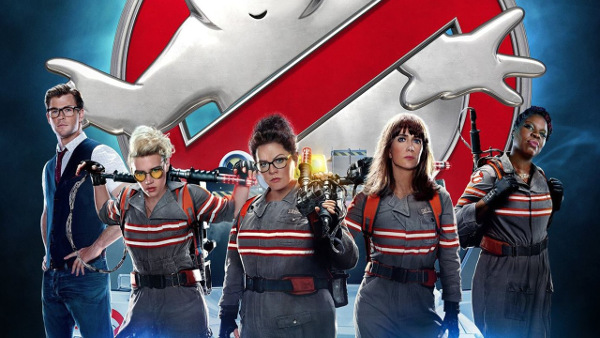
The female ghostbusters, with Chris Hemsworth.

…but there is, as one might expect, some overlap (the more-than-human often encounter others like them).[1] It includes, but is not limited to, the Vampire Detective Series. The Supernatural Detective is perhaps best understood as a subset of the Exotic Detective, where their unusual trait is specifically some supernatural characteristic. The crimes they solve may be mundane or mystical.

An illustrative sample follows. Let us know your favourites, including those we haven’t mentioned, in the comments or on twitter/facebook/tumblr.

The Vampire Detective

As noted above, vampire detectives have a trope of their own:

[T]his might be because vampires fit so easily into the Film Noir Private Detective with their tendency to be out at night, tendency to wear long coats, messy backstories, inevitable love difficulties, not-so-clean morality, and in some sense of the word, a drinking problem.[2]

Angel is the television exemplar – broody, dark, giving up the love of his undead existence, and in aesthetically film noir fashion (at least in season 1), using his powers to solve crime.
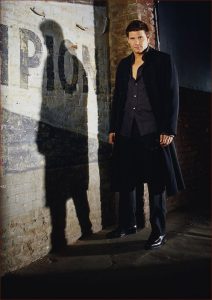
Angel, looking brooding in a long coat.

The Werewolf Detective

Need flexible working hours because you turn into a ravening monster at the full moon? No worries: become a detective. Larry Talbot – aka The Wolf Man – does just that in Neil Gaiman’s short stories Only the End of the World Again and Bay Wolf (an adaptation of Beowulf, as the name suggests).
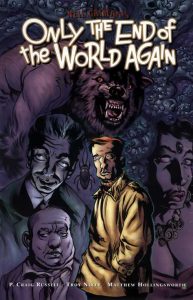
Cover art for Only the End of the World Again

The Superhero Detective

Although frequently male, the Supernatural Detective is not bound to a single gender. In both the comics and recent Netflix series, Jessica Jones – former superhero, with superhuman strength (and, in the comics at least, ability to fly) – works as a private investigator.
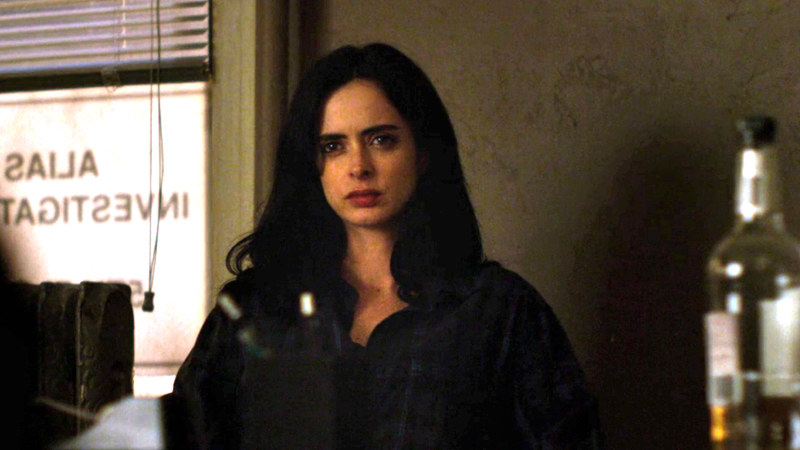
Jessica Jones in her office

And she’s not the only one. Marvel’s Jamie Madrox works as a PI in New York along with Wolfsbane and Strong Guy.

But perhaps best of all, DC’s Detective Chimp solves crimes while wearing a Sherlock Holmes-style deerstalker hat, frequently assisted by the Bureau of Amplified Animals, including Rex the Wonder Dog. This stuff writes itself.
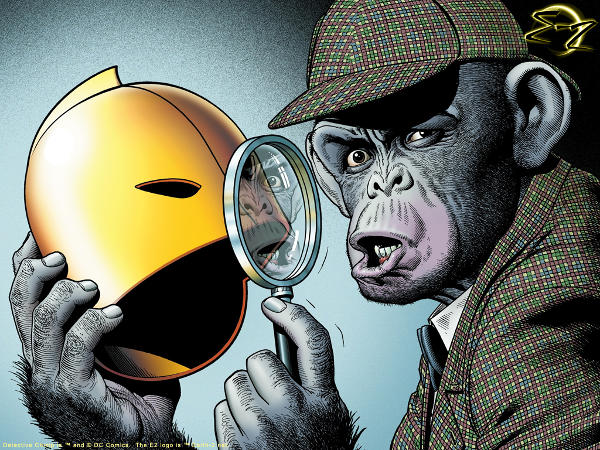
Detective Chimp, complete with trilby and magnifying glass

The Lord of Hell Detective

You’d think we were making it up, but no, even Lucifer gets a turn as a gumshoe. Based on Lucifer Morningstar from Sandman, and appearing in Vertigo’s Lucifer, the eponymous TV show follows the fallen angel as he “decides to help the LAPD Detective Chloe Decker solve homicides for his own amusement.”[3]
Lucifer and Chloe at a crime scene

Lucifer isn’t the only divine being to get caught up in the PI business – in the manga (and anime adaptation) The Mythical Detective Loki Ragnarok, the Norse trickster opens the Enjyaku Detective Agency to investigate the paranormal (and y’know, collect evil auras that take over human hearts in order to return to Asgard. It’s important to have hobbies).
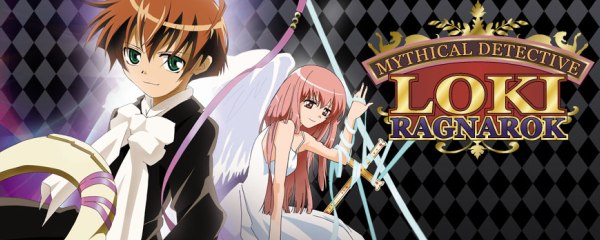
Promo banner for the Loki detective agency.

The Zombie Detective

In iZombie, the central character finds work at a morgue for a steady source of brains. ‘But that doesn’t sound like detective work!’, you exclaim.
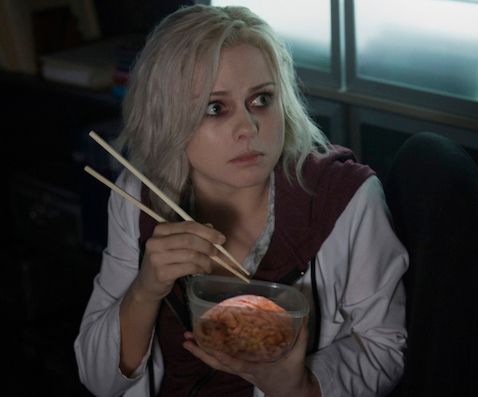
Zombie woman eating brains with chopsticks

Suspend your disbelief, dear reader:

Whenever Liv eats a dead person's brain, she temporarily inherits some of their personality traits and experiences flashbacks of their life. Those visions are generally triggered by sights (events or objects) or sounds (repeated sentences). In the case of murder victims, the flashbacks offer clues about their killers. Liv uses this new ability to help Police Detective Clive Babineaux solve the crimes, passing herself off as a psychic…[4]

A pseudo-psychic zombie two-for-one! Take that Simon Baker!
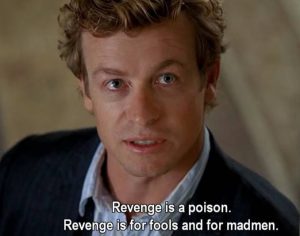
Simon Baker in the Mentalist, with the tagline: Revenge is a poison. Revenge is for fools and for madmen.

(Also, here’s a fun fact: The Walking Dead was almost a zombie detective show – but with zombie crimes, rather than zombie detectives. The Master notes that, having recently reached Series 4, he “would not have made it that far through a Zombie detective series.”)

The Extra Lucky Detective

I was originally going to call this section ‘The Magical Detective’. After all, it would be strange to have even one example to put under such a specific heading, but to my surprise, here are two:
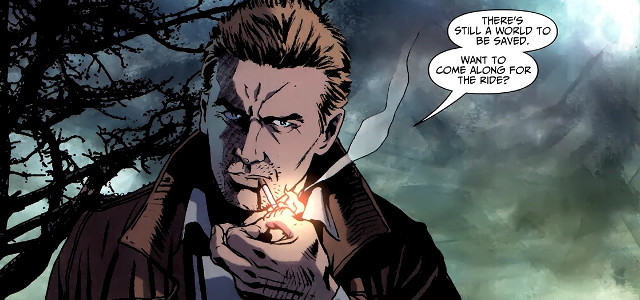
John Constantine, ready to save the world.

John Constantine of DC Comics fame (played by Keanu in the movie) has a range of magical powers including “synchronicity wave travelling… an instinctual supernatural ability for Constantine to make his own luck.”[5] Like Angel and Loki, he overlaps with the Occult Detective.

More recently, Stan Lee’s The Lucky Man has appeared on television, starring a homicide detective that can ‘control luck’ thanks to an ancient magical bracelet….
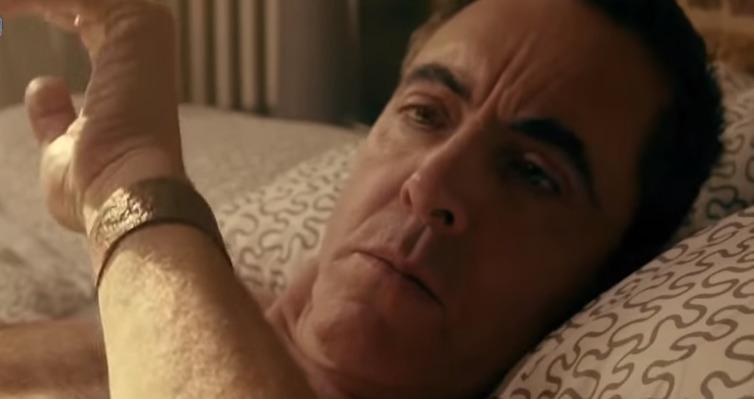
The Lucky Man examining his ancient bracelet.

I guess the FFX-2 Lady Luck suits weren’t available. Shame – he would’ve looked dashing.
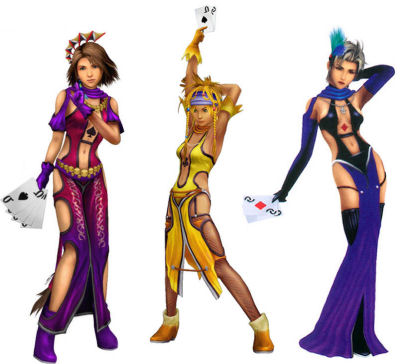
Yuna, Rikku and Paine from FFX-2 in their Lady Luck outfits


So that’s it for our first serving of pop(culture)corn – I hope it proved a tasty morsel. Know of any other examples, or alternative employment opportunities for the charmed/cursed/divine? Tell us in the comments, or on facebook/twitter/tumblr.

Footnotes

[1] For more examples of occult detectives, see this list. Sometimes the two are conflated, e.g. http://www.tor.com/2016/10/12/supernatural-detectives-we-love-to-drag-into-trouble/

[2] http://tvtropes.org/pmwiki/pmwiki.php/Main/VampireDetectiveSeries

[3] http://lucifer.wikia.com/wiki/Lucifer_(TV_series). NB. Eating people’s brains (or other body parts) to inherit their powers or memories is itself a trope: the Cannibalism Superpower.

[4] https://en.wikipedia.org/wiki/IZombie_(TV_series)

[5] https://en.wikipedia.org/wiki/John_Constantine#Powers_and_abilities
]]>
2
The Doctor http://www.stephrennick.com <![CDATA[Catherine Sangster, On Dictionaries, Pronunciation, and Geekery (Part 3)]]> https://www.epicureancure.com/?p=419 2017-08-11T21:24:42Z 2017-02-26T22:56:52Z Catherine Sangster is Head of Pronunciation for Oxford Dictionaries. Before moving into lexicography, she spent nine years in the BBC Pronunciation Unit, and completed a DPhil in sociolinguistics. Catherine's research interests include language and gender/sexuality, feminism, accents and dialects, Latin, Germanic languages, and the phonology of conlangs. In this final instalment, we discuss how dictionaries can be subversive, the connection between academia and fandom, and texts that do interesting things with language. You can find out more at Oxford Words, or keep up with Oxford Dictionaries on twitter @OxfordWords and @OED.

This is Part 3. If you missed them, here is Part 1 and here is Part 2.


TD: So, given that you can have multiple pronunciations of a word, and presumably multiple meanings of a word, is the continued existence of dictionaries – whether paper or digital – threatened by internet enterprises like Wiktionary or even the Urban Dictionary?

CS: Dictionaries basically are becoming an online thing. The Oxford English Dictionary is an online entity; it does of course also exist in physical form, but in terms of the updates that happen to it, and the way that most people work with it and use it, it’s an online thing. Now the ones you mentioned are crowd-sourced. If they’re not the sort of sites that scrape dictionary content and then present it, a lot of them are crowd sourced. I think that contemporary dictionary producers are interested in crowd sourcing, but that there’s a value to expert editorial input to weigh things and to make sure that there’s a balance, and people aren’t creating things the way they wish they were, rather than the way things actually are.

TD: That makes sense. Again, this is from the linguist, so do forgive me. Can dictionaries ever be subversive?

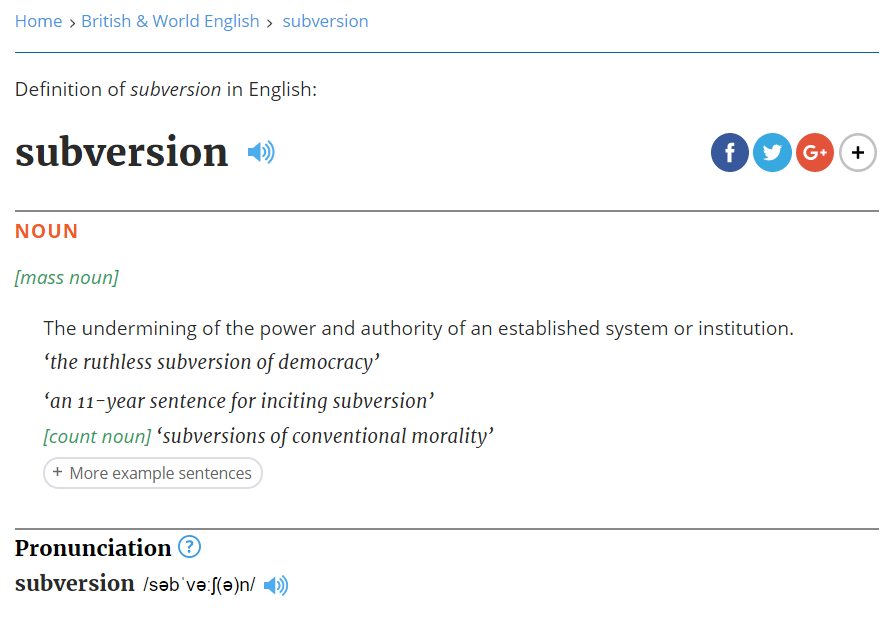
CS: I’d say lexicographers can certainly be subversive, yeah! There’s not a lot of scope for subversion in the pronunciation part of a dictionary entry, although probably not none; the decision for instance to include the northern ‘A’ (bath, glass) [rhyming with ass, not arse] forms subverted the norm of giving only the close RP versions.

In parts of the dictionary that aren’t my specialism I’m wary of speaking for my colleagues too much, but say you have a dictionary entry. As well as the pronunciation, part of speech, definition, and the etymology, you’d have some quotations or example sentences.

Dictionary entry for subversion

CS: Those are drawn from massive corpora of real data –we don’t make them up, they just exist in the world and an editor picks a few to illustrate exactly how the word might be used. Now if you’re picking three from a hundred, in exercising that choice you might subvert people’s expectations. For instance if it were a word that was particularly associated with one sort of thing you might – and you’d do it partly for lexicographical reasons because you want to demonstrate the range – pick one that would surprise or upset expectations.
I invited my colleague Fiona McPherson to weigh in on this, she says:

The main purpose in selecting the quotation evidence is, course, to reflect the way the term you are defining is used. I’m looking for apt, clear examples which help the reader to understand, rather than baffle them – otherwise I’m not doing my job. In saying that, it is the one area where we can get a little creative. All other things being equal, I do get a kick out of choosing an example from one of my favourite books, or perhaps one that shows my football team in a good light. I do also enjoy choosing a publication that is more unusual – maybe something that is less canonical than those which spring to mind when you think of the OED. Working as I do with new words, you often get that opportunity as those publications tend to be where that type of vocabulary is found. But that is only possible if the quotation is one which aids understanding. That always has to be the main objective.

TD: How would you explain the concept of a dictionary to an alien?

CS: Well, what’s the alien’s language? Does the alien have language in the way we understand it?

TD: Yes, let’s assume that there is some way to actually communicate with the alien.

CS: Okay. I’m going to restrict myself to talking about the pronunciation bits of the dictionary.

TD: Fair enough.

CS: Assuming the alien had some language, and that their language was produced physiologically by some part of their alien anatomy, I would say: these symbols here, the transcription symbols, are just a sequential indication of which bit of your anatomy – which bit of alien anatomy – interacts with which other bit of alien anatomy, to produce the sound which combines to make the language.

TD: That’s an excellent description!

[CS laughs]

TD: And probably helpful to non-aliens as well to be honest [laughs]. If you could bring any obsolete item of lexis back into popular use, what would it be?

CS: Oooh. One of the nice things about OED is that nothing gets removed. There are a lot of entries in OED which are obsolete, but they won’t be expunged or deleted. I come across words a lot, actually, as I’m working through, and I think ‘oh that’s ripe for coming back’.

TD: Linguistics questions aside, a couple of quick ones to end with. You mentioned you have a doctorate in sociophonetics, and obviously you have various academic interests. What role do you think academics can or should play in the production or consumption of geek culture?

CS: I was thinking about this recently, because I was looking at the term aca-fan. Often people are very keen to draw distinctions, you know, ‘it’s not the same as being someone who is simultaneously a fan of something and an academic’. I don’t think there should be an artificial distinction; I don’t think that academics fundamentally think about things in a different way. We might give ourselves more space to pick things apart, or we might bring particular frameworks of thinking about something to bear on whatever our particular fandom might be, but I see it as organically belonging together. And I think really anybody can analyse, if you listen to people geeking out – so, I enjoy tabletop games, I enjoy comics books, I enjoy Buffy and various…

TD: Anyone who doesn’t enjoy Buffy I don’t trust [she says, tongue in cheek].

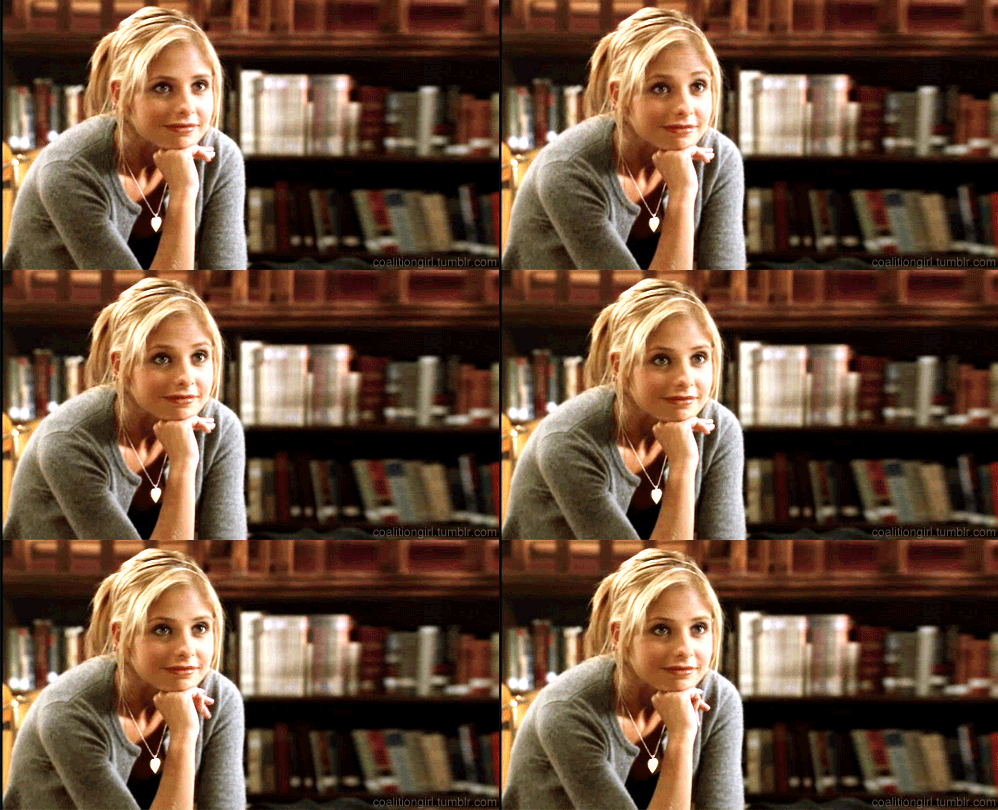
GIF of Buffy, raising her eyebrows while smiling.

CS: Well thinking about Buffy as an example, I’ve watched Buffy for many years and talked about Buffy with many people, friends who are academics and not, including people who were academically working on Buffy and not, and I don’t see a fundamental difference. You can pull it apart on gender lines, you can see things on a subsequent watching you hadn’t seen before, and that might be informed by your academic work or your readings or but those aren’t things that are locked up in the ivory tower especially, or they shouldn’t be.

TD: That’s a great answer. One of the things we do on the site quite a lot is talk about tropes. Do you have a favourite trope?

CS: Tropes are one of the things that feed a lot of the potential new additions to the dictionary in the areas I look at. Often they’re fairly niche and specific, and so they might not make it over the hurdle to get included. Something like 'Mary Sue' for instance as a trope, or 'Sexy Lamp Test' is certainly something that we’re looking at. I was trying to pin down a definition of Strong Female Character recently – the thing with tropes is that they’re really slippery. You know exactly what you mean by them, but they can be hard to nail down. I don’t think I have a favourite one; I’m very interested in them, and it’s fun to spot them, but I don’t think there’s a particular one that’s my favourite one of all.

TD: Are there any that you would like to stop seeing?

CS: Oh plenty! I’m trying to think of things I’ve watched recently.

TD: I know as soon as one puts that hat on then it’s just easy to get ragey about all the many things that they should really stop doing…

CS: When I think about tropes that really annoy me, it often boils down to limitations placed on female characters, of one sort of another.

TD: Agreed. Finally, do you have any recommendations for our readers: films to watch, TV series you’ve loved, books to read, or other recommendations?

CS: Oooh. I’ll pick ones that do interesting things with language…

TD: That would be great.

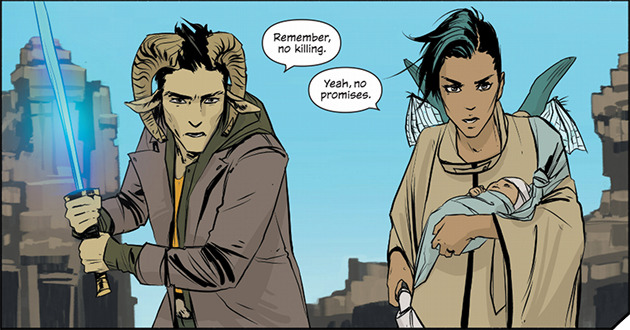
CS: Ok, a comic book – I’m sure many of your readers will already be familiar with it, but Brian Vaughan and Fiona Staples’ Saga series does really interesting things with language. It uses an existing invented language for one of its languages – Esperanto – and I’m very interested how languages get used in graphic novels in different ways. So yeah, Saga would be one.

Example panel from Saga

I wouldn’t say I’d wholeheartedly recommend it for various reasons, but there’s lot of interesting language stuff in Game of Thrones, and I do enjoy watching it, and problematising it as we academics love to.

I enjoy the Marvel Cinematic Universe in general, and there are some cool language things that go on for instance in Captain America: Civil War. I mentioned Scarlet Witch already, but also Zemo, Bucky and of course Black Panther with the Xhosa. I spoke about some of that at Nine Worlds this year. Agents of SHIELD has some nice language and translation bits too.

I’m trying to think if there are any board games with really good pronunciation dimensions to them but not among the ones I love, really. Although the word ‘meeple’ – which is a little character figure from a board game – is finding its way into the dictionary.

TD: Oh that’s cool.

CS: Well we’re seeing what we can do.

TD: Thank you very much for a really interesting chat!

CS: Thank you!

NB. This interview has been edited for clarity.


This is the third in a series of interviews with authors, developers, critics, journalists, and academics. If you'd like to make a suggestion, or be interviewed, do get in touch.

]]>
0