So you’ve clicked accidentally on Part 2, you’re showing previously latent masochistic tendencies or you excitedly, but alas mistakenly, think ‘Glottal Stop’ is something you remember from Pornhub – either or, we’re both here now so we might as well get on with it.
I recently completed a small, real-time analysis of Hermione Granger’s use of T-glottaling in the Harry Potter film franchise, as played by Emma Watson, which observed the T-glottaling variant in terms of the follow social and linguistic constraints:
- Age: does Hermione’s use of T-glottaling increase, decrease or remain static between pre-adolescence (the first film) and adolescence (the penultimate)?
- Audience: does Hermione T-glottal less or more depending on whether she’s talking to a peer, an adult or reading out loud?
- Word position: does Hermione T-glottal more or less depending on whether [t] occurs word-finally or medially? E.g. i/t/s, be/t/er v.s. rabbi/t/, ge/t/
- Phonetic environment: does Hermione T-glottal more or less depending on whether [t] occurs pre-consonantally (…tha/t/ country)…), pre-vocalically (…tha/t/ idea…), pre-pausally (…her ca/t/.) or intervocalically (…be/t/er…, …qui/t/e easy…)? It should be noted, if you weren’t already suffering from confusion-induced spasms at this stage, that when studying speech, we interpret data phonetically rather than orthographically – that is, how it is vocalised rather than how it is spelled (hence why it’s the [e] in easy that makes the [t] in quite easy intervocalic)
When one thinks of Hermione Granger, we conjure a speaker who is erudite, middle-class and, in the linguistic world that-which-should-not-be-claimed, ‘well-spoken’. Accumulating 260 tokens (instances where she could have used either [t] or [ʔ]) from the first film, Harry Potter and the Philosopher’s Stone, and the penultimate instalment, Harry Potter and The Deathly Hallows: Part One, the intention of the micro-study was to determine the real-time development in the use of T-glottaling variable between pre-adolescent and adolescent Hermione (data was also collected and disseminated for Harry but this article is a one-woman show). Heads-up regarding the tables: the ‘N’ row represents the number of tokens that occurred in that specific constraint (such as ‘word-medial’) and the ‘%’ row represents the percentage which occurred as the corresponding variable, listed above. These were the results:
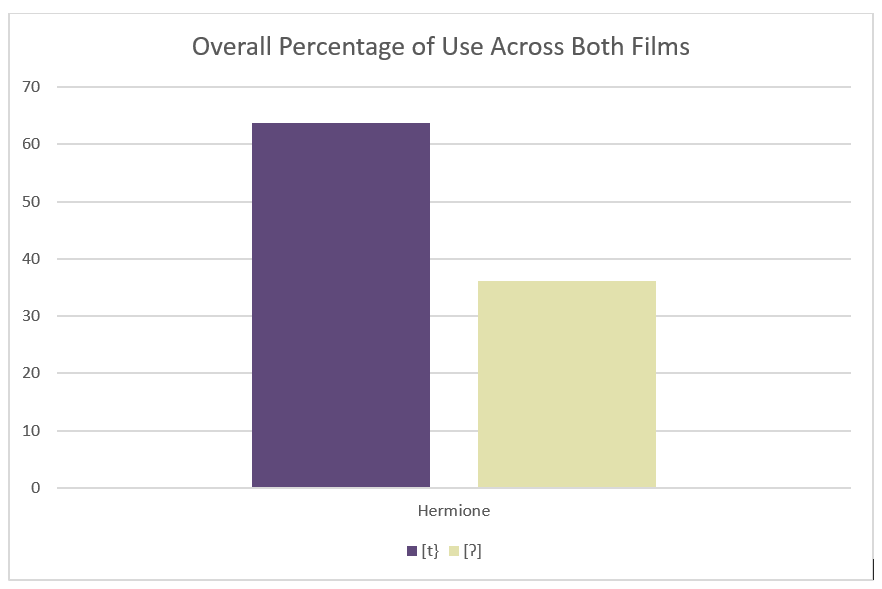
Figure 1: Overall % of /ʔ/ and /t/ used by Hermione
Overall, taking into consideration all tokens regardless of delineation, Hermione uses the standard variant (or alveolar plosive – I’ll enchant you with the IPA some other time) 63.8% of the time and T-glottals 36.2%. Unsurprisingly, a Received Pronunciation (RP) speaker like Hermione uses [t] more than [ʔ] in her speech. However, the reality, when we consider social and linguistic constraints like age and audience, word and phonetic environment, paint a rather more nuanced picture. Which means, you’ll be moistened to hear, lots more data!
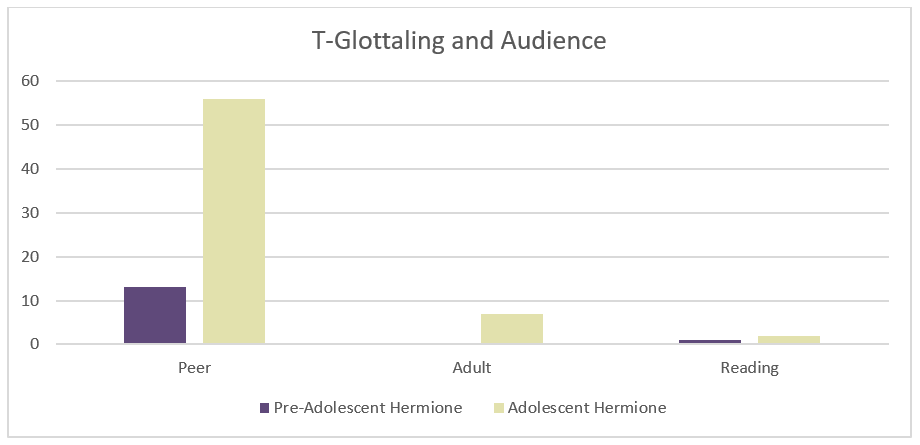
Figure 2: % of T-glottaling: adolescence and pre-adolescence vs. audience
Figure 2 details the extent to which Hermione style-shifts (or switches between standard and non-standard variables in response to a social situation, rather like when you deliberately enunciate around your gran to support the illusion that you, and you alone, are worthy of her inheritance) in her use of T-glottaling dependent on audience: whether she is communicating with a peer, an adult or reading aloud. Between the stages of pre-adolescence and adolescence, Hermione actually increases her use of T-glottaling from 13% to 56% respectively, reflecting the pressure to conform to peer norms of speech.[1] The data extracted for Hermione in the fields of adult conversation and reading aloud were unfortunately negligible but the substantial increase in her use of T-glottaling around peers (like Ron and Harry) reflects current sociolinguistic theory that non-standard variants are innovated by the young – y’ge/ʔ/ me?
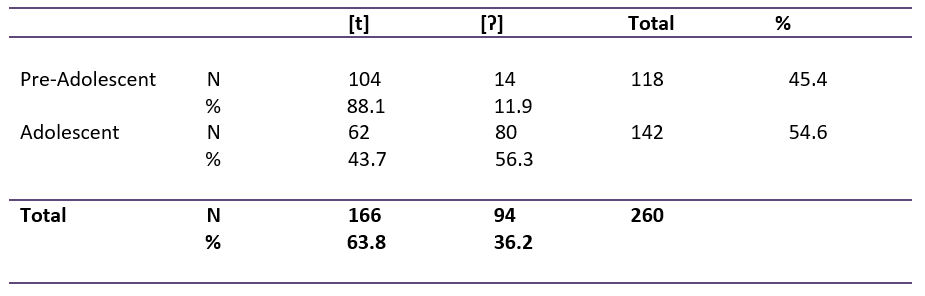
Table 1: Hermione: overall distribution of variants cross-tabulated with pre-adolescence and adolescence.
The result of Hermione’s distribution of variants cross-tabulated with her age in real-time are, amazingly, even more interesting (you could support a substantial marine ecosystem in my pants right now): they not only reflect the claims made by earlier studies[2] that young, middle-class females are the prime innovators of T-glottaling in Britain but also appear to support theories such as the Gender Paradox (explained below). Pre-adolescence, Hermione T-glottals at only 12% compared to 88% for the standard variant but by the penultimate film, Hermione fundamentally shifts in favour of T-glottaling: her use of the non-prestigious variant (outside of Cardiff, that is) soars to at 56.3% compared to 43.7% for [t]. William Labov, who essentially invented the field of sociolinguistics in his Master’s dissertation (bastard), outlined the Gender Paradox as a result of:
[S]table situations [where] women perceive and react to prestige or stigma more strongly than men do, and when change begins, women are quicker and more forceful [in] employing the new social symbolism, whatever it might be.[3]

It’s canon in the field of linguistics that, generally-speaking, women lead language change and development. There are, however, a number of caveats that should be remembered: sociolinguistic studies tend only to record data based on a gender binary (male and female) and this is largely an issue of practicality – it’s difficult to find non-binary, genderfluid etc. people in substantial-enough numbers in a delineated geographic space. There are, it should be said, new methods of analysing sociolinguistic data emerging that take into account much more detailed information about an individual such as ‘R’ software (oh dear god, don’t make me explain it – just know it is vast and complex and you should be afraid). Watch this space for an article all about the Gender Paradox in pop culture.
…young, middle-class females are the prime innovators of T-glottaling in Britain…
Rapidity certainly characterises Hermione’s shift and it supports previous research that younger people are increasingly responding more favourably to T-glottaling as its social stigma wanes.[4]
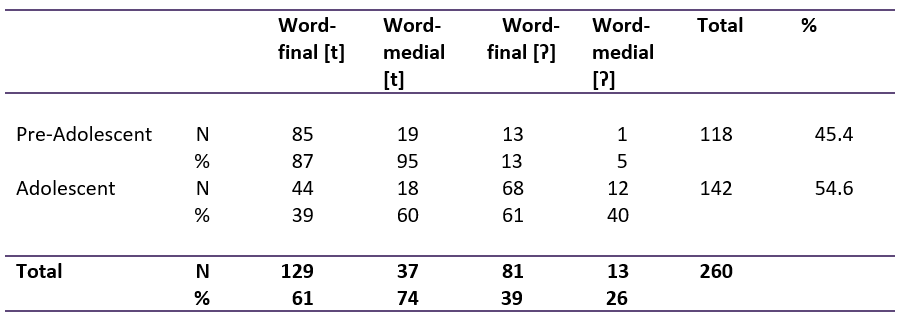
Table 2: Hermione: Cross-tabulation of word position vs. adolescence and pre-adolescence.
With regards to the development of T-glottaling in the RP sociolect, Hermione’s accent, it has previously been recorded that T-glottaling has found purchase amongst word-final environments but is largely excluded from word-medial positions (think back also to Harry Hart from Kingsman).[5] Evidence from the above tables, however, showing a cross-tabulation between word environment and age, seems to challenge this established norm. Firstly, the decline in instances of [t] in word-final position in the transition from pre-adolescence to adolescence, 87% to 39%, is – based on previous evidence we’ve looked at – to be expected, especially since word-final position is the most fecund area for [ʔ] adoption in RP speakers (and practically everyone else). That said, Hermione’s drop is considerable, but more intriguing is her drop in usage of word-medial [t], from 95% to 60%, and complimented by a corresponding rise in word-medial T-glottaling from 5% to 40%. Whilst it should be made clear fewer tokens were available for pre-adolescent Hermione, the fact that 40% of available tokens to adolescent Hermione were registered as [ʔ] is substantial. It ought to be added as a caveat, however, that it is unlikely to be word-bounded instances of T-glottaling that are infiltrating Hermione’s RP (e.g. bu/ʔ/er) and more likely unbounded, intervocalic (recall: occurring between two vowels) incidences as shown below in Table 3 (e.g. tha/ʔ/ easy). Either way, the result is in keeping with the female talent for linguistic innovation.
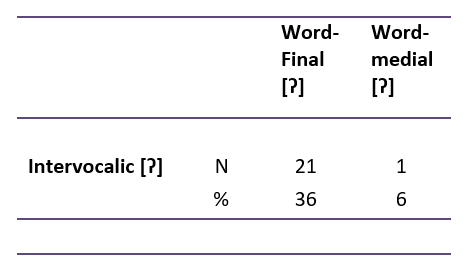
Table 3: Hermione: Cross-tabulation of T-glottaling in word-final and word-medial positions vs intervocalic phonetic environment
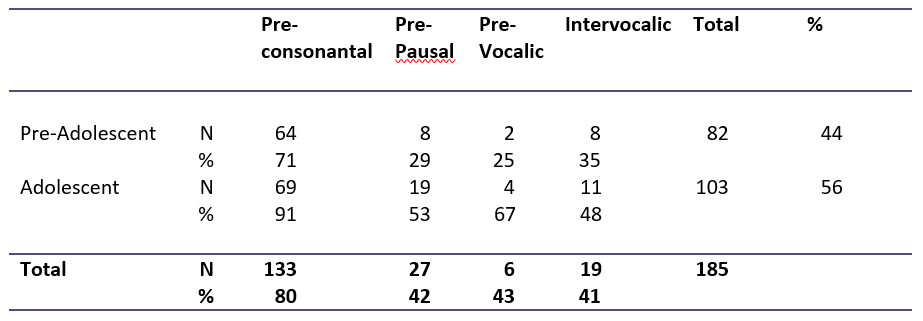
Table 4: Hermione: Cross-tabulation of T-glottaling in phonetic environment vs. adolescence and pre-adolescence.
Previous research[6] has contended that the linguistic diffusion (or spread) of T-glottaling can generally be understood as migrating along the pattern: PreConsonantal > PrePausal > PreVocalic.[7] Table 4 shows Hermione developing from T-glottaling pre-consonantally from 71% in pre-adolescence to 91% in adolescence – an expected trajectory. Despite pre-vocalic T-glottaling having a higher percentile development, the tokens were too few for the result to be credible and thus, developing in real-time from 29% to 53% pre-pausally, Hermione’s instances of [ʔ] in following phonetic environments seem to confirm the assertions of previous research. There was, however, an increase intervocalically – 35% to 48% - which, given it is the most stigmatised phonetic environment, is fascinating. Screw you, it is.
So there you have it. Not only Britain’s premier witch, Hermione Granger is a linguistic innovator, an agent of trope subversion, and a slayer of stereotypes; a middle-class, young, female who wields her glottals like a 10 ¾” vinewood with a dragon heartstring core. If you’ve any queries, drop a comment below and I’ll get back to you. Maybe.

Finally, I really ought to apologise as, in the course of reading this article, you’ve become the unwitting victim of the Sociolinguist’s Curse (the fourth one that Rowling missed out). Where once you would have sat blissfully on your IKEA couch, munching and slurping on whatever carcinogenic delights you’ve foraged from the kitchen, and watching The Order of the Phoenix for sixth time because you’re not sure if not-having-a-nose is oddly attractive, you’ll find yourself unconsciously listening, periodically jerked out from the film: did he…did he just glottal? Rewind. I don’t care about your Carpal Tunnel syndrome, Martha, pick up the remote and rewind the goddamn film!
Enjoy.
Footnotes
[1] Marshall, 2001: 63
[2] Mees & Collins, 1999; Stuart-Smith, 1999; Docherty & Foulkes, 1999
[3] Labov, 2001: 291
[4] Smith & Holmes, 2016; Trudgill, 1988
[5] Fabricus, 2002: 115; Mees & Collins, 1999: 202
[6] Straw & Patrick, 2003
[7] Fabricus has postulated that “the pre-pausal environment will become the next widely acceptable environment for T-glottalling, perhaps within the next generation or two” (2002: 133).
References
- Fabricus, Anne (2002). "Evidence for the disappearing stigma of t-glottalling: Ongoing change in modern RP", English World-Wide 23:1, 115–136.
- Labov, W. (2001). Principles of linguistic change, Vol. 2: Social factors. Oxford: Blackwell.
- Marshall, J. (2001), "The Sociolinguistic status of the glottal stop in Northeast Scots" www.rdg.ac.uk/AcaDepts/cl/slals/workingpapers/marshall.pdf
- Mees, I. & Collins, B. (1999). "Cardiff: a real-time study of glottalisation." In P. Foulkes & G. Docherty (eds.) Urban voices. London: Arnold. 185-2-2.
- Smith, J & Holmes, S, (2016), "The unstoppable glottal: tracking rapid change in an iconic British variable", not-yet-published.
- Straw, M & Patrick, P (2003) "Variation in the realisation of (t) in Ipswich" – NWAV 2003 abstract www.ling.upenn.edu/NWAVE/abs-pdf/patrick.pdf
Further Reading
Outside the texts referenced below and in the further reading section from Part One, I recommend, provided you’ve the time and the cringe-resistance, watching Carol Reed’s Oliver! (1968). It’s linguistic stereotyping in a nutshell (and Mark Lester, who plays the eponymous hero, later gave up acting and claimed he was the father of one of Michael Jackson’s kids, so, y’know, gossip!).
]]>